Important Note: The original version of the Rueda family history blog post was flagged for removal in February 2026. To make sure descendants of Colombia around the world do not lose access to their history, here is an edited and condensed version of that original page.
It's hard to tell what was wrong with the original page. If it was length, then this is abridged. Several conquistadors' biographies were cut, but you can easily find them via Google and other sources. If it was the descriptions of the colonial conquest of Latin America or the Transatlantic slave trade, how do you describe those horrific events in our history without using "insensitive" language? I hope the original version of this page can be restored.
Un abrazo de tu primo,
~ Edward A. Rueda
Haga clic aquí para ver una traducción automática en español.


Amazingly, a large number of santandereanos could claim descent from the Cacique Guanentá, the supreme ruler of the 16th-century Guane, according to an account left behind by a descendant, the priest Antonio Sánchez de Cozar Guanienta (c.1634-1698). Check out my detailed discussion of Antonio's surviving manuscript from 1696, Tratado de astronomía y la reformación del tiempo (Treatise on Astronomy and Reforming Time), which was the first book on astronomy written in Colombia, and can be read online on the Biblioteca Nacional de Colombia's website!

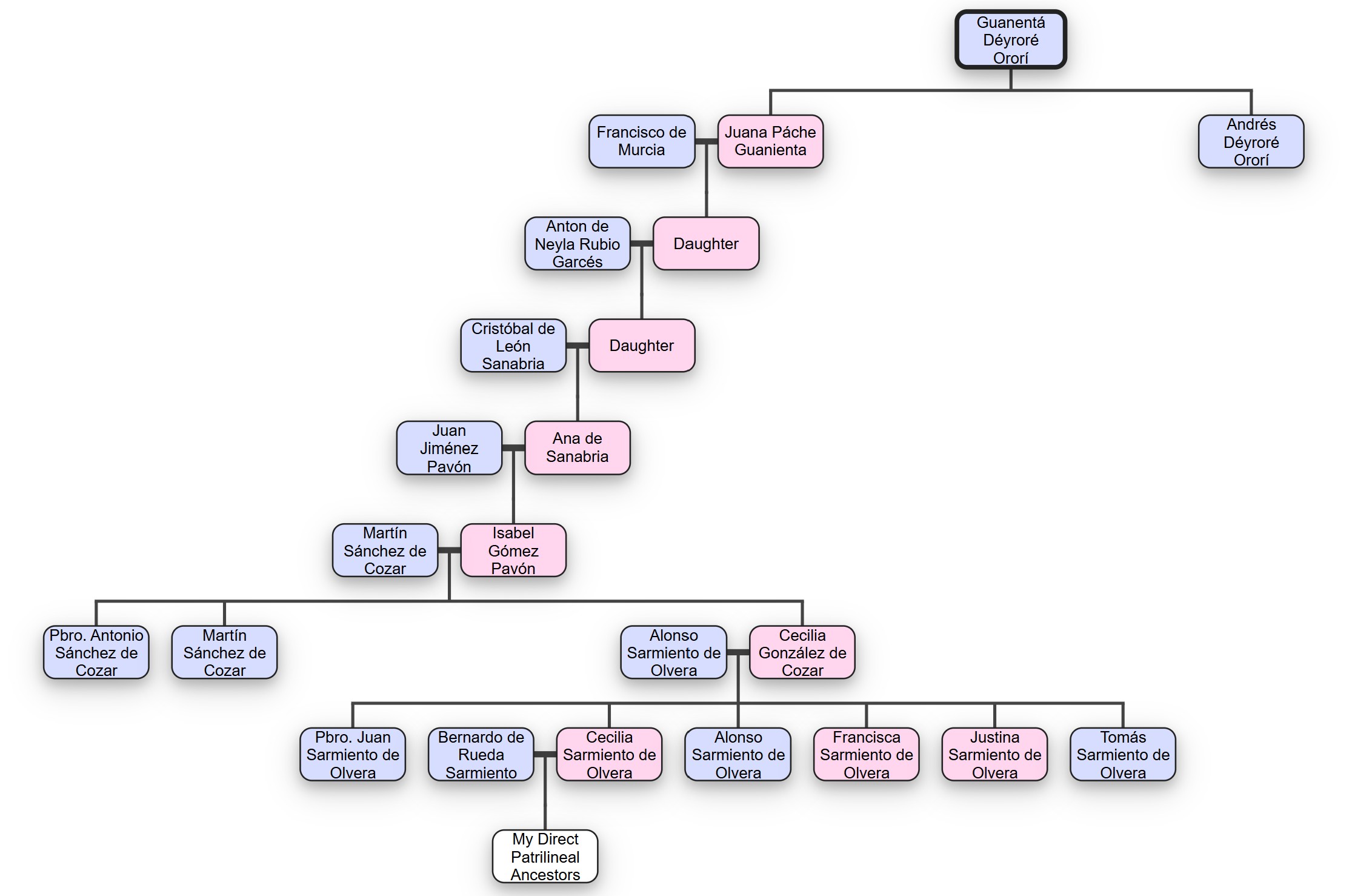
As Guane men died from hard slave labor, Guane women increasingly became servants to Spanish and creole settlers and bore their mestizo children. The Spanish praised Guanes' relatively pale skin as being "caucasoid," a description that still gets used today even when the anthropological evidence suggests otherwise. Colonial writers also marveled at how quickly the exploited Guane were willing to assimilate. Juan de Castellanos's often cited description of the Guane calls them a "white, clean, curious people," and notes of female Guane servants: "it is a marvel how [quickly] they take on the Castilian language, so well articulated the words, as if they came to them by inheritance." Yet the nimble adoption of Spanish customs did not translate into opportunities.
As the area's gold production declined from 80,000 pesos a year in the 1610s to just 2,000 pesos in 1634-1635, the Guane were forced onto arbitraty resguardos (reservations) in 1627 and increasingly marginalized. Spanish, creole, and mestizo settlers like my Rueda and Sarmiento ancestors occupied the stolen land, and carved up the outskirts of Vélez into more and more towns and parishes. While the number of assimilated mestizo descendants of the Guane (like the priest Antonio Sánchez de Cozar Guanienta) increased, the Guane Indian population fell so low by the late 1700s that the reservations were consolidated. The Guane language, which had been in decline since the early 1600s, received its death blow in 1770, when the Spanish crown forbade the teaching of Indigenous languages. The last census of the Guane in 1810 found only 1,824 Indians in five settlements, compared to an estimated 300,000 Indians in 1540, the time of Spanish conquest.
Santander's strongest cultural tie to the Guane Indians, the harvesting of hormigas culonas, is the subject of my favorite quote about Santandereanos. As famed naturalist José Celestino Mutis observed ants in 1777, he noted in his diary: “I have not yet been able to see the arriera-winged mothers to verify if these will be the ones that some Indians very much like to fry, as do the Americanos [Spanish colonists] of a few towns like Barichara. These people are scornfully nicknamed comehormigas [ant-eaters].” [Translation from Kingdom of Ants (2010) by Edward O. Wilson and José Gómez Durán]
And now, here is the genealogical nitty-gritty of my own "ant-eaters."


Rito Rueda Rueda Sr. (1939)
What all that means is that my distant male ancestor left East Africa for the Middle East between 70,000 to 60,000 years ago, presumably to escape droughts. He and his male descendants were nomadic hunter-gatherers who stayed in Southwest Asia until around 45,000 years ago, when my direct male ancestor was living in South Asia. His male descendants in turn were living in the steppes of Central Asia by around 35,000 to 30,000 years ago. My last common direct male ancestors with Native Americans lived around this time.
Between 22,000 to 17,000 years ago, my direct male ancestor had returned to South or West Asia and gave his male descendants the "M343" mutation, the tell-tale sign of the R1b haplogroup. This R1b haplogroup is made up of a large number of male lineages, as branches (or "subclades") roamed the Eurasian grasslands between Central Europe and Korea, and eventually reached Western Europe and Africa. According to National Geographic's Genographic Project, about 55% of Western European men, 21% of Eastern European men, 43% of Central Asian men, 6% of West Asian men, and 5% of South Asian men belong to the R1b haplogroup.
Unfortunately, some people have been misled by the prevalence of R1b in Europe, and called it a "European" haplogroup, or even worse, a "white" haplogroup. The simple fact is that R1b arose in South Asia or West Asia in a time before our modern racial differences or geographic regions meant anything. My forefather who founded my P312 subclade lived between 14,000 to 5,500 years ago in West Asia. His many male descendants are believed to have been among the proto-Indo-Europeans who spread from north of the Black Sea around 4000 BC (considered by many to be part of the "Yamna culture"). One branch became the "proto-Celts" in Spain by 2000 BC. National Geographic's Genographic Project says this P312 subclade accounts for about 1-2% of men in Lebanon, Iraq, and Kazakhstan, about 16% of men in France, and about 15-17% of men in Spain and Portugal.
It's interesting to note that this wave of nomadic settlers brought the wheel ("rueda" in Spanish), domesticated horses, and the use of bronze to western Europe. Once in Iberia, the proto-Indo-Europeans had families with descendants of the area's original Ice Age hunter-gatherers and the Neolithic farmers from the Levant who reached Spain around 8,000 years ago, forming the pre-Roman peoples of Iberia. Today, the average Spaniard's genetic legacy is about 50% Neolithic farmer, 30% proto-Indo-European, and 20% Ice Age hunter-gatherer, according to paleogeneticist Carles Lalueza-Fox. A 2019 study has further detailed the Iberian peninsula's genomic history over the last 8,000 years.
A 2017 genetic study suggests that my direct parental line has lived in Spain for more than 4,000 years. The DF27 mutation originated around 2200 BC in northeast Iberia, the Z220 mutation originated around 1300 BC in north-central Iberia (the eventual land of the Celts), and my personal haplogroup of R-CTS4065 arose sometime after that.
Cristóbal de Rueda's younger sons, Cristóbal and Alonso de Rueda Rosales, were born in Tunja, Colombia and joined a small group of creoles and mestizos and enslaved people who founded frontier towns in the Santander region in the 1600s. This area was officially part of the Province of Tunja until 1795, then was called the Province of Socorro until 1857, when it was renamed in honor of President Francisco de Paula Santander. The inhabitants of this beautiful, mountainous, and remote region become known for "gritty, self-made prosperity, and a certain ungovernability," to quote historian Richard Stoller.

Both Stoller and novelist Enrique Serrano note that the origins of Santander's settlers are largely obscure. Serrano calls the Santanderano heritage "a form of hispanidad, whose roots have not been traced with sufficiency or precision." He suspects this lack of information is deliberate, and that oftentimes settlers representing many forms of mestizaje, including recently converted Jewish and Muslim roots, wanted to escape the Inquisition of Cartagena and the officials of Tunja and Vélez.
Over time, Santandereanos and the regional historians tended to tell self-aggrandizing stories of their "noble" and "pure Castilian" heritage rather than investigate their multicultural history. My grandfather's book includes the ridiculous local lore that the heart of Don Quixote was said to be buried in San Gil. The Conde de Cuchicute, Don José María de Rueda y Gómez (1871-1945) was an extreme embodiment of this absurdity, as he created a fable of his nobility to match his feudal-style rule over a vast hacienda in Curití.

First Generation Note: The first few generations rely heavily on "Las genealogías del Nuevo Reino de Granada" by the 17th-century genealogist Juan Flórez de Ocáriz. His first volume has information on Martín Galeano's family and the Ortíz Galeano and Gorraiz families and his second volume has information on the families of Francisca Inga and Francisco Fernández de Contreras, and the Gutiérrez de Aponte, Poveda, Rueda, and Sarmiento families.


1. Inés Ortíz Galeano, whose family continues below.

1. Luisa Vázquez, whose family continues below.

1. María de Poveda, whose family continues below.
2. Ana de Poveda
3. Captain Francisco de Poveda, who died while fighting the Yariguí Indians.
4. Alonso de Poveda
~ Martín Galeano (c.1505-1554?), an uncle of Juana Franco de Poveda, was one of the most ruthless and effective conquistadores of Colombia. Probably born in Valencia del Mombuey, Badajoz, Extremadura, Martín joined the army of Emperor Carlos V, fought in Italy under the command of General Antonio de Leyva, and probably took part in the Battle of Pavia (1525). By 1535 Martín was back in Spain, and the historian Avellaneda notes that Martín signed up on July 26 of that year to be part of Pedro de Mendoza's expedition to Río de la Plata. He is listed as the son of Juan Miguel Galeano and María Ruíz, residents of Valencia. However Martín chose not to join Mendoza and become a founder of Buenos Aires, and instead set sail with the armada of adelantado Pedro Fernández de Lugo, to become an eventual founder of Bogotá. Ten ships carrying between 1,000 to 1,200 passengers left Santa Cruz, Tenerife in the Canary Islands in November 1535 and arrived at Santa Marta with great fanfare on January 2, 1536.

By March 1537 they had reached the realm of the Muiscas, headed by the chieftain Bacatá, whose village of the same name became the city of Bogotá and whose name eventually graced Colombia's tallest skyscraper. The Muisca nursed the Spaniards back to health but then hid the majority of their treasure when they realized the Spaniards' true intentions. The Spanish invaders' advantages of steel, guns, horses, and new diseases like smallpox quickly wore down Muisca resistance. Bacatá and other rulers like the cacique of Sogamoso abandoned their villages and fled into the mountains, and Bacatá's vast wealth (the now legendary "Gold of El Dorado") has not been located to this day. Quemuenchatocha, the zaque of Hunza and the second-most powerful Muisca lord, chose to fight the Spanish, but his troops quickly lost on August 20, 1537 and he was taken captive. The majority of gold and emeralds stolen by Jiménez de Quesada came from the subsequent looting of Hunza. In June 1538, the surviving 173 Spaniards (including Martín) got their official share of the loot: at least 510 pesos of fine gold, 57 pesos of gold alloy, and five emeralds. Jiménez de Quesada got nine of those shares, and Governor Lugo got 10 shares.

The Spaniards settled in the Muisca village of Bacatá and christened it "Santa Fe de Bogotá" on August 6, 1538. A major surprise came the following February, when the expeditions of Federman and Sebastián de Belalcázar arrived in the area within weeks of each other. With roughly 480 European treasure hunters now gathered in Bogotá, Jiménez de Quesada decided to "found" the city once more on April 27, 1539 and settle two more cities. The Muisca village of Hunza was officially "founded" and renamed Tunja on August 6, 1539. Jiménez de Quesada entrusted Martín Galeano with founding the third city.
Martín Galeano traveled to the northernmost Muisca lands in what is now Santander Department, and chose the village of Ubasá to become his city of Vélez, which he "founded" on June 6, 1539. Martín traveled further north in 1540, into the realm of the Guanes, a civilization that interacted with the Muisca but spoke a language distinct from Chibcha, the Muisca language. During a systematic conquest of the Guane over the next three years, many caciques — Chalalá, Macaregua, Chanchón, and the powerful Guanentá — valiantly fought the Spanish and lost. The caciques' names live on in Santander's geography, and to this day santandereanos refer to themselves as "guanentinos," after the cacique who lived on the majestic outcrop of Jérira, now Mesa de los Santos.
An accomplished administrator as well as a warrior, Martín Galeano owned the encomiendas of Chipatá, Guane, Guavatá, Orta, Saboyá, and Yacarebo, served as the chief justice of Vélez from 1539-1543 and 1546-1551, ran a store that sold goods from Spain, and even tried to build and operate a road to the nearby Carare River. But all this industry depended on slave labor, and starting in 1547 Martín faced legal trouble for the "innumerable deaths and cruelties that he [had] done to the Indians." The colonial court first assigned Martín to military service against the Muzo Indians, which seems like a strange punishment for the crime, but then his sentences worsened. In 1551, Martín lost his title of chief justice and was fined 100 pesos of fine gold, and then in 1554 was taken into custody, and forced onto a ship bound for Spain (for more details, read "La provincia de Guanentá: orígenes de sus poblamientos urbanos"). Most historians agree that Martín died as the ship was passing by the Bahamas.
Martín's only child, an illegitimate daughter named Marina Galeano, died childless, but his widow Isabel Juan de Arroyo had many descendants from her first marriage, including a great-great-great-granddaughter who married the genealogist Juan Flórez de Ocáriz. In "Las genealogías del Nuevo Reino de Granada," Flórez de Ocáriz gave Martín Galeano special treatment, placing the chapter on his family immediately after that of Jiménez de Quesada. While Flórez de Ocáriz did not even list Martín's parents, he claimed that Martín came from a "nobilísimo" family from Genova, Italy, and died of old age in Vélez. My grandfather, Rito Rueda Rueda, wrote that he viewed in Vélez the dilapidated house of Martín Galeano, which had outlasted its owner by four centuries.

1. Captain Benito Franco de Velasco
2. Juana Franco, seen above, who married the conquistador Alonso de Poveda.

Francisca was taken from a palace in Cajamarca, Peru by Captain Juan Muñoz de Collantes (born 1501 in Granada, Andalucía, Spain), a member of Francisco Pizarro's expedition that arrived in Peru in 1531 and looted Cuzco in 1533. It's unclear whether Juan kidnapped Francisca, or whether she was escaping the Inca Atahualpa, who was waging civil war. Either way, Francisca became Juan's concubine and they had a daughter, Mencia. In 1540 or 1541, the three of them traveled from Peru to Bogotá, Colombia, following the path of conquistador Sebastián de Belalcázar. The historian José Ignacio Avellaneda Navas notes that Francisca was "the person most directly connected with a royal house, of everyone who made the Nuevo Reino [Colombia] their homeland." Francisca settled in Bogotá and died a few years later in the nearby town of Tocaima, Cundinamarca, Colombia (established in 1544).
~ Francisca Inga and Juan Muñoz de Collantes had one daughter:
1. Mencia de Collantes (born in Cuzco, Peru), whose family continues below.


1. Lorenzo Hernández
2. Francisco Hernández
3. Pedro Hernández
4. Ana de Rojas
5. María Hernández
6. Juan Hernández
7. Isabel de Rojas
8. Juana de Rojas, who married in 1583 in Pamplona.
9. Francisca de Rojas (baptized January 1577 in Pamplona), whose family continues below.


1. Fernando Sotomayor, whose family continues below.
~ Alonso Garzón de Tahuste and María de Aguilar were presumably born in Spain and settled in Timaná, Huila, Colombia. Flórez de Ocáriz includes the poignant fact that they were married for over 50 years, at a time when the average life expectancy was about 35 years old. Their children were:
1. Alonso Garzón de Tahuste (c.1555-c.1644), the parish priest at the Cathedral of Santa Fe de Bogotá for 59 years, who was a pioneer of liturgical music in Colombia.
2. Juan Garzón de Tahuste, another priest.
3. Francisco de Aguilar
4. Ana Garzón de Tahuste, whose family continues below.
4. María Fernández y Rangel (baptized 1584 in Pamplona)
5. Lucía Fernández y Rangel (baptized 1587 in Pamplona)
6. Ana Fernández y Rangel (baptized 1588 in Pamplona)
1. Cristóbal Jaimes, whose family continues below.
~ Francisco Trujillo Salas, a captain who emigrated to Nueva Granada, and Leonor de Valencia were natives of Jerez de los Caballeros, Badajoz, Extremadura, Spain who married and had at least a daughter:
1. María Bautista Mayor Bazan, whose family continues below.
~ Simón del Basto (born c.1510), an exploitative conquistador, married Juana de Avellaneda, probably the daughter of Juan de Avellaneda, a member of Nikolaus Federmann's expedition (1536-1539), and their six children included:
1. María del Basto, whose family continues below.

1. Juan Calderón de la Barca, who left for the Indies, and whose family continues below.
~ Pedro then married a second time to Costanza Pérez and their children included:
1. Pedro Calderón de la Barca (baptized 1531), who inherited the Casa de Calderón from his father and became a secretary for the king in Madrid. His son, Diego Calderón de la Barca (born 1550s), also inherited the casa and became a secretary for the king. Among the children of Diego were:
a. José Calderón de la Barca (died 1645), who fought in the army of the Conde Duque de Olivares (the prime minister immortalized in Diego Velázquez's portraits)
b. Pedro Calderón de la Barca (1600-1681), one of the greatest writers of Spain's Golden Age, who is still world-renowned for his poetry and drama.
~ Lanzarote then married Ana de Beaumont y Navarra, from another pro-Spanish Navarrese noble family. Among Ana's great-grandfathers were Carlos de Beaumont (1361-1432), a diplomat and the illegitimate son of a Navarrese prince, and the king he served, Carlos III of Navarra (1361-1425). Carlos and Carlos were descended from France's House of Capet, including the canonized King Louis IX (1214-1270), who is problematic from a Jewish perspective. An exhaustive genealogy can be found in Los Beaumont: un linaje navarro de sangre Real by Basque genealogist Iñaki Garrido Yerobi. You can read about how I came across the Beaumont family ties here, and further details are here. Keep in mind that I only know about the Colombian descendants of this line from secondary sources, so I welcome your skepticism.


Priego de Córdoba, Andalucía, Spain (Google Maps)
1. Damiana Pérez de Rosales (born 1571; died c.1647 in Tunja), whose family continues below.
~ Inés Ortíz Galeano married Lorenzo Benítez Burros Bermejas Capotes y Galvanes (born c.1520), who was from Almendralejo, Extremadura, Spain and whose family originally came from Cabeza del Buey, Extremadura. Lorenzo came to Colombia around 1550, secured an encomienda to exploit the Indians of Caícota in 1556, and was among the residents of Vélez accused of mistreating Indians in 1561. He served as teniente de alcalde (lieutenant mayor) in the Río del Oro area from 1562-1572, before he was forced out of office. Lorenzo then inherited the encomiendas of Itierra, Misaque, Queregana, y Carahota from his father-in-law in 1576 and eventually had encomiendas in Yerva, Siscota, Sube, and Choagüete. Inés Ortíz was listed as a widow in the 1620 census of Tunja, living with her widowed daugher. Lorenzo and Inés had six children, order unknown:
2. Fray Alonso Ortíz Galeano (born 1567 in Vélez; died 1639 in Guane), a Dominican priest who raised by a Guane wet nurse and became famous for speaking the language of the Guane Indians (and possibly his maternal grandmother).
3. Juana Galeano, who married Juan de Ugarte Larrinaga, an administrator of the "mitayos," enslaved Indians forced to do labor under the "mita" system.
4. Ana Benítez Galeano, who first married Andrés de Buyza and then married Captain Martín Gómez, who died in the "War of the Yariguies," fighting the Yariguí Indians near Vélez. Ana Benítez was listed as a widow in the 1620 census of Tunja, living with her widowed mother, Inés Ortíz.
5. Pedro Ortíz Galeano
6. another son named Pedro or Lorenzo Ortíz Galeano
~ Captain Juan Delgado (born c.1542) lived in Colombia by 1561, married María de Poveda, and lived in Muzo, Boyacá, Colombia, which is renowned for having the world's best emerald mine. In 1609, Juan testified in a legal case in Bogotá that "he knew many of the conquerors and settlers of this kingdom," and his father-in-law, Alonso de Poveda, came to Colombia as part of the expedition of Nikolaus Federmann (1536-1539).
~ The children of Juan Delgado and María de Poveda included:
1. Catalina Delgado, whose family continues below.
~ Alonso de Soto married Mencia de Collantes, who was born in Cuzco, Peru, and their children included:
~ Alonso de Olivera Sarmiento married Mariana de Guerra y Valderrama and they had at least a son:
~ Francisco Sánchez Herreño married Catalina Hernández and their children included:
~ Francisco Sánchez de la Nava (a.k.a. Francisco Sánchez Herreño) was a priest in Vélez who disregarded his vows of chastity and had a relationship with Beatríz de Torres, a mestiza woman from the Muisca/Chibcha settlement of Turmequé, and they had at least an illegitimate daughter:
~ Juan Bermúdez married Beatríz González and their children included:
1. Juan Bermúdez Canario (born on the island of Tenerife in the Canary Islands), whose family continues below.
2. Francisco Bermúdez
~ Gonzalo Hernández Gironda was a conquistador who married Beatríz Arias and had a daughter:
1. Inés de Salazar (born in the Canary Islands), whose family continues below.
1. Antonio de la Parra, whose family continues below.
~ Gonzalo Hernández Cano (a.k.a. Gonzalo Cano) and his wife Juana lived in Azuaga, Badajoz, Spain during the late 1500s, when it was one of the largest towns in the region of Extremadura and a center for textiles and dye manufacturing. Azuaga was named by the Arabs after the Berber tribe Al-Zuwaga and famed for having a chapter of the prestigious Orden de Santiago. Many azuagueños named Cano who were probably relatives settled in the Americas, including García Hernández de Merchán Cano (born c.1540), who settled in Pasto, Colombia and whose descendants were named Merchancano.
The children of Gonzalo and Juana included:
1. Isabel García Cano, whose family continues below.

Azuaga, Spain (Google Maps)
2. Marina de Gorostizaga, whose family continues below.
~ Gonzalo Gómez de Orozco Domínguez appears to be the direct-male ancestor of the Acevedo family of Santander, Colombia, as opposed to his brother Pedro. In 1582, Gonzalo married Isabel de Acevedo in Pamplona, and their children included:
2. Agueda Gómez de Orozco y Acevedo (baptized 1588 in Pamplona)
3. Francisco Gómez de Orozco y Acevedo (baptized 1590 in Pamplona)
4. Pedro de Acevedo (baptized October 11, 1591 in Pamplona), whose family continues below.
~ Fernando de Sotomayor (born in Cáceres, Extremadura, Spain; died 1599 in Fusagasugá, Cundinamarca, Colombia) was according to Flórez de Ocáriz an encomendero in "the city of Nuestra Señora de Altagracia de los Utagaos," which I intrepret as Nuestra Señora de Altagracia de Sumapáz (now Fusagasugá), which was in the territory of the Sutagaos Indians. Fernando married Leonor de Figueroa and their children included:
1. Pedro de Sotomayor, whose family continues below.
~ Martín Calderón (born in La Mancha, Spain) married Ana Garzón de Tahuste and their children included:
1. Ana Garzón de Tahuste, whose family continues below.
~ Cristóbal Jaimes, an exploitative conquistador, married María Bautista Mayor Bazan, and their children included:
1. Juan Jaimes y Bazan, whose family continues below.
2. Cristóbal Jaimes y Bazan (baptized 1577 in Pamplona)
~ Juan Calderón de la Barca, an exploitative conquistador, married María del Basto and their children included:
2. María Calderón de la Barca (baptized 1581 in Pamplona)
~ Some sources say Juan was the father of Juan Calderón de la Fuente, a soldier who in turn was the father of Diego Paredes Calderón, a Tunja resident who married Isabel Holguín. I believe they are mistaken, as the historian Avellaneda shows that the father of Juan Calderón de la Fuente was also named Diego Paredes Calderón (c.1515-after 1588), a conquistador from Ronda, Spain who took part in Jiménez de Quesada's expedition and settled in Tunja.

Tunja, Colombia (Google Maps)
1. Inés Benítez Galeano, a nun at the Convent de la Concepción in Tunja, Boyacá.
2. Lorenzo Felipe Benítez Galeano, whose family continues below.
3. Fray Joseph Ortíz Galeano, who was an Augustinian monk and a prior.
4. Pedro Ortíz Galiano Matajudíos (born c.1618), who married and had a family.
~ Captain Pedro de Ardila came from Castilla la Vieja, Spain and arrived at Vélez in 1540 with Jerónimo Lebrón de Quiñones, where he led the infantry and served as regidor (alderman). Pedro owned an encomienda in Choaguete and a gold mine near Bucaramanga. The Bogotá authorities heard that Pedro forced the Indians of his encomienda to work in his mine, and after a long court case (1572-1576) he was fined 70 pesos in 20-karat gold.
1. Pedro de Ardila, a magistrate of Vélez.
2. Baltazar de Ardila, who never married.
3. Juan de Ardila, who married Gabriela de Bahamonde and had a family.
4. Eufemia de Ardila, who never married.
5. María de Ardila y Miranda, who first married Andrés Hernández de Abrego and then married Alonso Pardo de Moya, and had families with both husbands.
6. Ana de Ardila, who never married.
7. Luisa de Ardila, who married Captain Diego Ruíz de la Peña Montoya (born 1575). One of their sons, Juan de la Peña Montoya, went back to Spain to fight in the army of King Felipe IV, helped defeat the French in the Battle of Fuenterrabía (1638) and died while fighting in Catalonia in 1640. The Franco-Spanish War dragged on until 1659, when the peace treaty resulted in the marriage of Louis XIV of France and Infanta María Teresa of Spain.
8. Melchora de Ardila, who never married.
9. Lucía de Ardila y Aponte, whose family continues below.
~ Captain Juan Sarmiento de Olivera (or Olvera) was born in Jérez de la Frontera, Andalucía, Spain, came to the New World around 1590, and married Francisca González de la Nava in Vélez around 1600. Juan and a man who became his son-in-law, Juan Díaz Bermúdez, were granted royal permission in 1609 to have Indians work on their haciendas in Vélez. There were five daughters and two sons of Juan Sarmiento and Francisca González (read the previous blog post for more information), and they were:

1. Antonio Bermúdez, who inherited an encomienda in Queca from his maternal grandfather, Gonzalo Hernández Gironda, following a lawsuit with his stepfather lasting from 1568-1572.
2. Beatríz Bermúdez
3. Gonzalo Bermúdez de Salazar (c.1550-1625), a priest in Bogotá who famously sermonized and taught in the Chibcha language.
4. Isabel de Salazar
5. Juan Díaz Bermúdez (born in Sanlúcar de Barrameda, Andalucía, Spain), whose family continues below.
6. Francisca Bermúdez
~ After Juan Bermúdez's death, Inés de Salazar married Diego de Vergara, an attorney and encomendero who lived in Bogotá, and they had another 11 children.
~ Antonio de la Parra was probably born in Arévalo, Ávila, Spain and moved to Azuaga, Badajoz, where he married Isabel García Cano on September 12, 1604.

~ Martín Sánchez de Cozar (born in Villanueva de los Infantes, Spain) married Isabel Gómez Pabón and their children included:
1. Cecilia González de Cozar (baptized August 30, 1635 in Guane), whose family continues below.
2. María de Cozar, whose family continues below.
3. Martín Sánchez de Cozar (born c.1644), who served as the alcalde ordinario of San Gil in 1707.
~ A Guane Indian woman who lived in the town of Guane, whose name is lost to history, had at least a daughter:
1. Madalena López (born early 1600s; probably died 1655 in Chanchón, now Socorro), whose family continues below.
~ Francisco de Uribe married Marina de Gorostizaga on December 4, 1607 in the Iglesia de los Santos Juanes in Bilbao, Bizkaia, Spain. Their children included:
1. Pedro de Uribe Salazar (baptized February 5, 1609 in Bilbao, Spain), whose family continues below.
~ Pedro de Amaya married Agustina de Villaroel in Spain and their children included:
1. Juan de Amaya Villaroel (born in Arcos de la Frontera, Andalucía, Spain; died c.1689 in San Gil, Colombia), whose family continues below.
~ Alonso Hernández Mohedano y Blasco, who was born in Mérida, Extremadura, Spain and was a "close relative" of the humanist Benito Arias Montano, married María de Collantes, who was born in Bogotá. Their 14 children included:
2. Catalina de Collantes, the mother of Bishop Lucas Fernández de Piedrahita of Santa Marta (1624-1688), the author of "Historia general de las conquistas del Nuevo Reyno de Granada."
4. Olaya Collantes (1614-1690), who married Pedro Correa and was a foremother of the elite of Antioquia, Colombia. Presidents of Colombia who are descended from Olaya include Pedro Nel Ospina, Mariano Ospina Pérez, and Alfonso López Michelsen. The painter Fernando Botero (1932-2023) is Olaya's 9th-great-grandson and may be her most accomplished descendant.
5. Ana Blasco, whose family continues below.
1. Pedro Gómez de Orozco y Sotomayor, whose family continues below.
1. Alonso de Sotomayor Garzón de Tahuste, whose family continues below.
~ Juan Jaimes married Elvira Calderón de la Barca on April 13, 1591 in Pamplona. The marriage record and notarial record detailing Elvira's dowry lists her name as "Elvira de Herrera," the same name as her presumed paternal grandmother. That is the strongest evidence linking Elvira back to the noble Calderón de la Barca family of Cantabria, Spain. The bones of Elvira Calderón were buried in the "Iglesia Mayor" of Pamplona on March 18, 1616, so she had died long before. Juan and Elvira had at least 11 children, including:
1. Mónica Jaimes Calderón (baptized 1591 in Pamplona)
2. Cristóbal Jaimes Calderón (baptized 1593 in Pamplona)
3. Juan Jaimes Calderón (baptized 1601 in Pamplona)
4. Fabiana Jaimes Calderón (baptized 1601 in Pamplona)
5. Jacinto Jaimes Calderón (baptized 1603 in Pamplona)
6. Juana Jaimes Calderón (baptized 1603 in Pamplona)
7. (probably) Francisca Jaimes Calderón, whose family continues below.

5. Pablo de Rueda Sarmiento (died c.1694 in San Gil)
6. Felipe de Rueda Sarmiento
10. Francisco de Rueda Sarmiento (born c.1657; died c.1703 in San Gil)
~ Alonso de Rueda Rosales had an illegitimate daughter:
1. Catalina de Rueda, who married Salvador de Medina and whose daughter, Antonia de Medina, is an heir in Alonso's 1681 will.
1. Francisca de la Peña Montoya (who is also called "Fulana Sarmiento" in another source). Her family continues below.
~ Alonso de Rueda married Gerónima Ramírez de Poveda around 1659, after the death of Margarita, and had three more children:
1. Juan de Rueda Ramírez (born 1661; baptized 1664 in Moncora)
2. José de Rueda Ramírez (born 1664; baptized 1666 in Moncora)
3. María de Rueda Ramírez (baptized 1671 in Moncora)
~ Catalina Sarmiento de Olvera and her first husband, Cristóbal de Rueda Rosales, the son of the Spanish immigrant, had at least six children (order uncertain):
~ Catalina Sarmiento then was married around 1640 in Vélez to Captain Manuel Gómez Romano, a.k.a. Manuel Currea Betancur (born c.1616 in Portugal), and they lived into the 1680s. The surname Currea stems from the border of Galicia and Portugal, and Betancur/Betancourt was originally the Norman surname Bettencourt, an old French family with an extensive Portuguese branch. Many "Portuguese" in the New World were actually conversos, recent Christians of Jewish ancestry, but that cannot be assumed of every Portuguese settler. Some of the descendants of Manuel and Catalina used the last name "Gómez Romano," while others used the last name "Gómez Currea," "Gómez Currea Betancourt," or "Currea Betancur."
The children of Manuel and Catalina included (order unknown):
3. Ignacio Currea Betancur, a.k.a. Ignacio Gómez Sarmiento (born c.1643; died 1724 in San Gil), who married Francisca Sarmiento de Olvera and whose last testament mentions that his father Manuel was born in Portugal. Ignacio served as the alcalde ordinario of San Gil in 1702.
4. Catalina Gómez Romano y Sarmiento (baptized September 17, 1646 in Moncora), whose family continues below.
5. Manuel Gómez Romano y Sarmiento (born c.1650; died February 6, 1732 in San Gil), whose family continues below.
6. María Gómez Romano y Sarmiento (baptized April 1, 1650 in Moncora), who is said to have married Pedro Gómez de Orozco and whose family continues below.
2. Francisco Díaz Sarmiento, who married Gertrudis del Castillo y Aviles and whose children were the "Díaz del Castillo" family.
3. María Díaz Sarmiento (baptized 1637 in Moncora)
4. Catarina Díaz Sarmiento (baptized December 29, 1640 in Vélez), whose family continues below.
5. Gracia Díaz Sarmiento (baptized September 12, 1643 in Vélez; buried August 14, 1733 in Girón), whose family continues below.
6. Alonso Díaz Sarmiento (baptized July 26, 1649 in Girón)
2. Lázaro de Quiñones (baptized August 15, 1646 in Girón)
~ Juana de Quiñones married Andrés Rodríguez de la Cruz and lived in Girón. In 1669, Juana reported that her husband had abandoned her, and asked authorities for permission to take control of his real estate and livestock. They had one daughter:
1. Úrsula de Quiñones (baptized November 14, 1659 in Girón; possibly buried Februray 7, 1744 in Girón), whose family continues below.
~ Diego Martínez de Ponte and Catalina Inclán de Estrada were natives of the Oviedo region of Asturias, Spain who married and who had at least a son:
1. Luis Martínez de Ponte (born c.1636 in Pravia, Asturias, Spain), whose family continues below.
~ Alonso Sarmiento de Olvera, an infantry captain who fought the Yariguíes Indians and later helped settle Girón, married Cecilia González de Cozar (baptized August 30, 1635 in Guane) and their children included:
1. Juan Sarmiento, who was a bachiller and priest by 1681.
2. Cecilia Sarmiento de Olvera (born 1661; baptized 1664 in Moncora), whose family continues below.
1. María Díaz y Cozar, whose family continues below.
2. Feliciana Díaz y Cozar (baptized 1656 in Moncora, now Guane), who married Pablo de Rueda Rosales (died 1694), the son of Alonso de Rueda Rosales and Margarita Sarmiento.
~ Lorenzo Felipe Benítez Galeano married Lucía de Ardila y Aponte (a.k.a. Lucía de Aponte y Miranda) on August 8, 1622 in Vélez, and their children included:
1. Catalina Benítez Galeano (baptized 1623 in Vélez), who married Juan de la Parra Cabeza de Vaca, a criollo from Tunja.
2. Baltazar Benítez Galeano (baptized 1625 in Vélez)
3. Francisca Benítez Galeano (baptized December 1, 1627 in Vélez), whose family continues below.
4. Eufemia Benítez Galeano (baptized 1631 in Vélez), who never married.
~ Juan de la Parra Cano (baptized August 14, 1625 in Azuaga, Extremadura, Spain; died c.1699 in San Gil, Colombia) came to Colombia and eventually became a "mayor of the Santa Hermandad" (keeper of the peace) in Vélez, and in 1673 was given an encomienda in Sumita, Sacane, Guacha and Taquica. He later became one of the founders of San Gil and an encomendero in Charalá. Juan married Francisca Benítez Galeano (baptized 1627 in Vélez) and their children included (order unknown):
10. Paula de la Parra Cano

1. Margarita de Amaya y Rueda (born 1672; baptized February 1, 1674 at age 1 year and 11.5 months in Guane), whose family continues below.
2. Pedro de Amaya y Rueda (born c.1675)
3. Tomás de Amaya y Rueda (born 1677; baptized 1679 in Guane), who married in 1694.
~ Juan de Amaya Villaroel also had an illegitimate daughter, Agustina de Amaya (born c.1667)
~ Manuel Gómez Farelo was born in Portugal, came to Colombia, and married Lucía González de Azcárraga, who was born in Vélez, Colombia. Their birthplaces are mentioned in their son Pablo's will. The 20th-century historian Ramiro Gómez Ramírez falsified a backstory for Manuel and Lucía, saying they were born in Spain and settled in Girón since they were "attracted by mining veins." Their children included:
2. Leonor Gómez Farelo y González (baptized 1637 in Guane)
3. Pedro Gómez Farelo y González (baptized 1639 in Guane)
4. Manuel Gómez Farelo y González (baptized 1642 in Guane)
6. Lorenzo Gómez Farelo y González (baptized 1648 in Guane)
7. Francisco Gómez Farelo y González (baptized 1651 in Guane)
8. Lucía Gómez Farelo y González (baptized 1654 in Guane)
~ Gonzalo de Ardila, who was probably the grandson of the conquistador Pedro de Ardila, married Madalena Mejía and their children included:
1. Juan de Ardila (died c.1715 in San Gil), whose family continues below.
2. Gonzalo de Ardila (died c.1714 in San Gil)
~ Madalena López (born early 1600s; probably died 1655 in Chanchón, now Socorro), the mestiza daughter of a Guane Indian woman, whose children included:
1. Ana de Ribera, whose family continues below.
2. María de Ribera
~ Gonzalo de Pineda married Micaela de Meneses on January 10, 1660 in Chanchón (now Socorro). 18th-cenutry marriage dispensation records claimed that Micaela was the sister of Jerónima Meneses de Moreno, but I'm not aware of earlier records that clarify the Meneses family history. The children of Gonzalo and Micaela included:
2. Ana de Pineda (baptized 1665 in Chanchón)
3. Josefa de Pineda (born 1665, baptized 1666 in Chanchón)
~ José Martín Moreno (died c.1696 in San Gil), an exploitative slave owner who did not know how to write, was married for 26 years to Leonor Gómez. They had eight children, including Manuel, Pedro, Juana, Madalena, Francisca, Ana, and Luisa Moreno.
~ After his first wife died, José married Jerónima Meneses on September 5, 1673 in Chanchón (now Socorro). 18th-cenutry marriage dispensation records claimed that Jerónima was the sister of Micaela Meneses de Pineda, but I'm not aware of earlier records that clarify the Meneses family history. José Moreno and Jerónima Meneses had 10 children:
1. Cristóbal Moreno Meneses, who died young.
2. Josefa Martín Moreno Meneses (born 1675, baptized April 5, 1676 in Chanchón at age 6 months; died c.1765; possibly buried June 6, 1765 in Socorro?), whose family continues below.
3. Manuel Moreno Meneses (born 1677; baptized 1679 in Chanchón)
4. Cristóbal Moreno Meneses, a second son with the same name.
6. Manuela Moreno Meneses
7. María Moreno Meneses (baptized 1682 in Chanchón)
8. Teresa Moreno Meneses
9. Inés Moreno Meneses
10. Juana María Moreno Meneses
~ Felipe de Arenas married María de los Ángeles y Porras, who may descended from María de los Ángeles, the daughter of conquistador Juan de Castro, who went on Federman's expedition to Colombia (1536-1539) and Beatríz Osorio. Felipe and María had at least one son:
1. Bernardo de Arenas (died 1704 in San Gil, Colombia), whose family continues below.
~ José Antonio Márquez de la Plata y Arévalo (born 1645? in Sevilla, Andalucía, Spain) was described as five years old in the 1650 will of his father, Pedro Márquez Rivadeneira (Source), although most published genealogies claim he was born c.1629. José Antonio and his brother added "de la Plata" (Silver) to their last name, although it's unclear whether historian Horacio Rodríguez Plata is right by claiming it was because José Antonio was a silversmith. José Antonio married Ana María Domínguez (although probably later than the published date of 1659) in Sevilla and their children included:
~ Juan Serrano Solano and Francisca Jaimes Calderón (died 1696) married on July 21, 1632 in Pamplona and lived in the tiny town of Guaca, Santander, Colombia. In 1663, Juan was listed as a leader of Guaca's hermandad de Nuestra Señora de Socorro, a religious group that venerated a local painting of the Virgin Mary. It's unclear whether Juan was related to the Serrano Cortés family of Pamplona, Vélez, and Socorro. As mentioned above, Francisca was probably a granddaughter of the conquistador Cristóbal Jaimes and the immigrant Juan Calderón de la Barca. The children of Juan and Francisca included:
1. Juan Serrano Solano, whose will written in Pamplona in 1688 provides evidence about this family.
2. Diego Serrano Solano, whose probable family continues below.
3. Alonso Serrano Solano
4. Juana de Uribe Salazar (died c.1702 in San Gil), who married Juan Martínez de Aparicio.
1. María Ana de Sotomayor y Blasco, whose family continues below. Genealogías de Santa Fé de Bogotá says that María Ana's parents were Spaniards, but that is based on an erroneous 1809 genealogy of the Acevedo family, mentioned further below.

5. Juan Manuel de Rueda Sarmiento (born 1682, baptized 1683 in Guane), who may be "Juan" listed above.
7. Marcelo de Rueda Sarmiento (born 1689, baptized 1692 in San Gil; died 1758 in Guane)
8. Lucía de Rueda Sarmiento (born 1691, baptized 1692 at age 1 year and 5 months in Guane), whose family continues below.
~ Gabriel Ángel Ortíz Navarro (born c.1649 in Sevilla, Andulcía, Spain; buried March 7, 1723 in San Gil), who served as the alcalde ordinario of San Gil in 1708, first married Juana Gómez Romano, and their children included:
1. Juan Victor Ortíz Navarro (baptized 1672 in Guane)
~ Pablo Gómez Farelo (baptized January 25, 1635 in Guane; died 1705 in Guane) and Juana de Pineda (born 1660s; died 1725 in Guane) married on July 18, 1677 in Guane and their children included:
1. Juan Gómez Farelo y Pineda (baptized 1678 in Guane; died 1762 in Socorro) was first married in 1704 in Guane to Josefa de Rueda Sarmiento (died 1728 in Guane) and later remarried.
5. Bernardo Gómez Farelo
1. Pedro Gómez Romano de la Parra (born c.1680; baptized 1682 in Moncora, now Guane; died 1739 in San Gil).
2. Catalina Gómez Romano de la Parra (born c.1684; baptized 1685 in Moncora), whose descendants include the politician Salvador Camacho Roldán (1827-1900).
3. Francisca Gómez Romano de la Parra (born/baptized 1685 in Moncora).
4. Pablo Gómez Romano de la Parra (born 1687; baptized September 7, 1687 at age 2 months in Moncora; buried May 15, 1773 in Barichara), whose family continues below.
5. María Gómez Romano de la Parra (born/baptized 1689 in Moncora).
6. Diego Gómez Romano de la Parra (born c.1693 in San Gil; baptized 1697 in San Gil; died 1772 in San Gil). Among his grandchildren were the "Tribune of the People" José Acevedo y Gómez (1772-1817) and the politicians Miguel Tadeo Gómez Durán (1784) and Diego Fernando Gómez Durán (1786-1853). The historian and writer Josefa Acevedo y Tejada (1803-1861) was his great-granddaughter.
7. Ignacio Gómez Romano, who married his cousin Francisca Sarmiento.

1. Catarina de la Parra Jaimes, whose family continues immediately below.
~ Miguel Ignacio de Aguiluz y Wandurraga, a.k.a. Miguel de Wandurraga, was of Basque origin and also spelled his name "Ubandurraga." His last names in Euskera are "Egiluz" (from hegi luze, meaning "long slope") and "Urandurraga" or "Undurraga" (meaning roughly "abundance of cliffs"). Miguel married Catarina de la Parra Jaimes, and their children included:
1. Rafaela Aguilus Wandurraga de la Parra (born c.1710 in San Gil; buried January 1780 in Barichara), whose family continues below.
2. Ignacio Javier Wandurraga de la Parra (born c.1723, baptized 1728 in San Gil)
3. Antonia Teresa Wandurraga de la Parra (born and baptized 1727 in San Gil)

~ Antonio Tomás de la Parra Benítez (born c.1657; died 1729 in San Gil), a founder of San Gil who served as the town's alcalde ordinario in 1711 and alcalde ordinario mas antiguo in 1713, married Margarita de Amaya y Rueda (born 1672) on January 7, 1685 in Moncora (now Guane), and they had five children:
1. Juan de la Parra Amaya
2. Felipe de la Parra Amaya
3. Bárbara de la Parra Amaya, who married in 1718 Francisco Pradilla y Ayerbe (born 1673 in Borja, Zaragoza, Spain; died 1748 in Barichara), the founder of Barichara. One of their 12 children, José Martín Pradilla de la Parra (1720-1802), was Barichara's first parish priest. One great-grandson, Antonio María Pradilla Rueda (1822-1878), was president of the state of Santander and a minister for several Colombian presidents.
4. Francisca de la Parra Amaya, who married Juan del Castillo.
5. María Rosa de la Parra Amaya (probably buried June 7, 1775 in Zapatoca), whose family continues below.
~ Juan de Ardila (died c.1715 in San Gil) first married Ana de Ribera on May 9, 1657 in Chanchón (now Socorro), celebrating a double wedding with Juan's brother, Gonzalo de Ardila, and Ana's sister, María de Ribera. The children of Juan and Ana included (order unknown):
1. Alberto de Ardila y Ribera
2. María de Ardila y Ribera
3. Sebastián de Ardila y Ribera, who married María de la Parra Cano (daughter of Francisco de la Parra Cano y Benítez).
4. Manuel de Ardila y Ribera, who married Margarita de la Parra Cano (daughter of Francisco de la Parra Cano y Benítez).
5. Juan Gilberto de Ardila y Ribera (born c.1666, baptized 1667 in Chanchón)
6. Gertrudis de Ardila y Ribera, who married Captain Fernando de Luque y Luna.
7. Felipe de Ardila y Ribera (born c.1669, baptized 1670 in Chanchón)
8. Juan de Ardila y Ribera (born 1671, baptized 1672 in Chanchón)
9. Ciriaco de Ardila y Ribera (born c.1676, baptized 1677 in Chanchón)
10. Cristóbal de Ardila y Ribera (born c.1678, baptized 1679 in Chanchón), whose family of revolutionaries continues below.
11. Ana Magdalena de Ardila y Ribera
12. Pascuala de Ardila y Ribera, whose family continues below.
~ Juan de Ardila had a second marriage with Rosa Reina, and fathered one son, Juan José de Ardila. Juan then had a third marriage with Juana de Cardenas Zapata, resulting in four more children: Juan Cristóbal, Juan Bernardo, Juan Gerónimo, and Juana María de Ardila.
2. Francisco Cayetano de la Plata Moreno
3. Simón Faustino de la Plata Moreno (born January 5, 1696; baptized August 15, 1696 at age 7 months and 10 days in Socorro; buried March 20, 1764 in Barichara), whose family continues below.
4. María Teresa de la Plata Moreno
5. Juan Bernardo de la Plata Moreno (baptized 1699 in Socorro), a twin.
6. Pedro José de la Plata Moreno (baptized 1699 in Socorro), a twin who died young.
7. Juana Josefa de la Plata Moreno
8. Manuel José de la Plata Moreno
9. Francisco Matías de la Plata Moreno (born 1705; baptized June 9, 1705 at age 4 months in Socorro), whose family continues below. He was the father of a Comunero leader, Carlos José Plata Benítez, and the grandfather of another Comunero leader, José Vicencio Plata Uribe.
10. Ana María de la Plata Moreno (baptized 1708 in Socorro), a twin.
11. Juan Antonio de la Plata Moreno (baptized 1708 in Socorro), a twin who died young.
12. Pedro José de la Plata Moreno, the father of Pablo Francisco Plata (1773-1843), a priest who signed Colombia's declaration of independence and served as the rector of the Colegio San Bartolomé and the dean of Bogotá's cathedral.
13. Pedro Antonio de la Plata Moreno (born and baptized 1712 in Socorro; died 1765 in San Gil) was the mayor of San Gil when he was stabbed to death by Pablo Mayorga, an Afro-Colombian described as "color pardo" (brown). Court documents suggest that Pedro had tried to seduce Mayorga's wife days before the stabbing. Later historians wrote that Pedro was stabbed by his own slave, which is false. Mayorga was sentenced to death in 1770 and died in jail the following year. Pedro was the grandfather of Antonia Santos Plata (1782-1819), the heroine and guerrilla leader who died for Colombia's independence, and the great-great-great-grandfather of the Conde de Cuchicute, José María de Rueda y Gómez (1871-1945). His descendants also include Presidents Eduardo Santos and Juan Manuel Santos and their families.
~ Josefa Martín Moreno outlived all but five of her children: María Teresa Plata, Juan Bernardo Plata, Ana María Plata, Pedro José Plata, and Pedro Antonio Plata.
2. María Benítez (baptized 1683 in Girón)
3. Miguel Gerónimo Benítez (baptized 1687 in Girón)
4. Juan Benítez (baptized 1690 in Girón)
5. Simona Benítez (baptized 1691 in Girón)
~ Luis Martínez de Ponte [or Martínez de Aponte] (born in Pravia, Asturias, Spain; died c.1696 in San Gil, Colombia) and Marcela de Rueda Sarmiento (died before 1681) married c.1658 in Moncora and had 9 children:
1. Diego Martínez de Ponte y Rueda (c.1658-c.1710)
2. Marcelo Martínez de Ponte y Rueda
3. Margarita Martínez de Ponte y Rueda
4. Catalina Martínez de Ponte y Rueda (baptized 1665 in Moncora)
5. María Martínez de Ponte y Rueda (baptized 1666 in Moncora)
6. Damiana Martínez de Ponte y Rueda (born 1667; baptized December 28, 1669 at age 2 years and 8 months in Moncora; died 1725 in San Gil), whose family continues below.
7. Alonso Martínez de Ponte y Rueda (born c.1670)
8. Fernando Martínez de Ponte y Rueda
9. Luis Martínez de Ponte y Rueda (born c.1674)
~ Juan Rodríguez Duran (born c.1631 in Garrovillas de Alconétar, Extremadura, Spain), a founder of San Gil, married Francisca de Rueda Sarmiento and their children included:
1. Cristóbal Rodríguez Durán y Rueda (born c.1654), whose family continues immediately below.
3. Clara Rodríguez Durán y Rueda (baptized 1660 in Girón)
4. José Rodríguez Durán y Rueda (baptized 1665 in Girón; died c.1737 in San Gil, Colombia), who married Josefa Moreno de Arroyo.
~ Cristóbal Rodríguez Durán y Rueda (born c.1654), a founder of San Gil, married his relative María Díaz y Cozar, and their children included:
1. María Durán y Díaz (baptized September 9, 1680 in Guane), whose family continues below.
~ Juan Rodríguez Durán y Rueda (born c.1657), a founder of San Gil who served as the town's alcalde ordinario mas antiguo in 1709, married his cousin Damiana Martínez de Aponte y Rueda (born 1667 in Moncora; died 1725 in San Gil) and their children included:
1. Juana Rodríguez Durán y Martínez (born c.1689; baptized April 24, 1691 at age 2 years in Guane), whose family continues below.
~ Toribio González del Busto (born in Asturias) settled in Colombia and married Catarina Díaz Sarmiento (baptized 1640 in Vélez). Their children included:
1. Catalina González Díaz, whose family continues immediately below.
3. Santiago González Díaz (born 1669; baptized April 1, 1671 at age 1 year and 10 months in Girón), whose family continues below.
~ Francisca de la Peña Montoya (who is called "Fulana Sarmiento" in another source), had at least two children, according to a 1738 marriage dispensation:
4. Francisca de la Prada García
5. Raimundo de la Prada García
6. Antonio de la Prada García
7. Agustina de la Prada García
8. José de la Prada García
~ Bernardo de Arenas (died 1704 in San Gil) first married María de Zabala, the daughter of Agustín de Zabala, and they had three children:
1. Inés de Arenas, who married Juan de Uribe Franco.
2. Felipe de Arenas Zabala, whose family continues below.
3. Lorenzo de Arenas
After his first wife's death, Bernardo married Micaela Ponce de Mendoza, and their children included:
4. María de Arenas Mendoza, whose family continues below.
5. Matías de Arenas Mendoza
6. Ana de Arenas Mendoza
7. Juana de Arenas Mendoza
2. Juan de Vesga Santiago
3. Simón de Vesga Santiago (baptized 1665 in Chanchón)
4. Pedro de Vesga Santiago
5. Nicolás de Vesga Santiago (born and baptized 1680 in Girón)
6. Francisca de Vesga Santiago
7. María de Vesga Santiago (died c.1691-1695), whose family continues below.
8. María Pascuala de Vesga Santiago, whose family continues below.
9. Ana de Vesga Santiago
~ After her husband's death, Antonia de Uribe married José Durán, and they had no children.
1. Francisca Gómez de Orozco y Gómez Romano, whose family continues immediately below.
~ María Ortíz de Zárate (born and died in Colombia), an exploitative slave owner whose last name was Basque, and her first husband (name unknown) had at least a son:
1. Andrés Cortés de la Peñuela (born c.1695; buried December 12, 1775 in Zapatoca), whose family continues below.
~ María's second husband was Diego Martínez de Aponte y Rueda (c.1657-c.1710), and their children included:
2. Diego Martínez y Zárate (baptized 1695 in Guane)
3. Marcela Martínez y Zárate (baptized 1696 in Guane)
4. Agustín Martínez y Zárate (baptized 1699 in Guane)
5. Luis Martínez y Zárate (baptized 1701 in Guane)
6. María Martínez y Zárate (died c.1772-1777), whose family continues below.
7. Martín Martínez y Zárate (baptized 1710 in Guane; died 1774 in Guane)
~ María married her third husband, Juan de León Santana, on January 20, 1716 in Guane. Juan was fined by authorities in 1723 for hiding slaves (who were probably smuggled). Before Juan paid his fine, he had two of his slaves stolen, so María sold two of her own enslaved people, "mulatos" named Leandro and Basilio, to pay the fine. María was listed as the godmother of various San Gil children until 1736.
~ It's possible María Ortíz de Zárate was descended from the "ancient and noble House of Zárate de Aguirre," located in the village of Vitoriano or Marquina, in the province of Álava, Spain. I discuss this further here.
~ Domingo de Torres married Casilda de Zárate on June 12, 1678 in Chanchón (now Socorro), Colombia. Casilda may be the woman of the same name who was the daughter of Diego Ortíz de Zárate (baptized 1634 in Vélez) and Agustina de la Peñuela (a great-great-granddaughter of Bartolomé Hernández Herreño). Given their names, María Ortíz de Zárate and her children, including Andrés Cortés de la Peñuela, were possibly descended from Diego Ortíz de Zárate and Agustina de la Peñuela as well. Diego was the son of Domingo Ortíz de Zárate, who came to Colombia in 1629, making Casilda a supposed descendant of the noble Ortíz de Zárate and Salazar families, the Iberian Jiménez dynasty, and the Houses of Ayala, Ungo de Velasco, San Pelayo, Castro, and Osorio. Domingo and Casilda were probably the parents of:
1. Angela de Torres y Zárate, whose family continues below.
~ Diego Serrano Solano, probably the son of Juan Serrano Solano and Francisca Jaimes Calderón, married Catalina González del Busto y Díaz. Their children included:
1. José Serrano Solano y González (born c.1681; buried January 17, 1755 in Zapatoca), whose family continues below.
2. Hipólita Serrano Solano y González (born c.1682; baptized April 26, 1683 at age 8 months in Girón; probably buried February 21, 1754 in Guane), whose family continues below.
3. Simón Serrano Solano y González (baptized February 1685 in Girón)
4. Salvadora Serrano Solano y González (baptized April 13, 1686 in Girón; buried April 10, 1758 in Zapatoca), whose family continues below.
5. Baltasar Serrano Solano y González (baptized March 1687 in Girón; died 1758 in Girón)
6. Ana Úrsula Serrano Solano y González (baptized April 21, 1696 in Girón; buried February 27, 1768), whose family continues below.
~ In May 2019, I found a compelling string of evidence linking the Serrano Solano family back to the medieval Calderón de la Barca family of Cantabria, Spain. I discuss this here.
Sixth Generation

Zapatoca, Colombia (Google Maps)
1. Alonso de Rueda Ortíz
2. Bernardo de Rueda Ortíz (born c.1703; buried March 1, 1771 in Zapatoca), whose family continues below.
5. Francisco Javier de Rueda Ortíz (c.1709)
6. Antonio de Rueda Ortíz (baptized 1711 in Guane; died 1776 in Zapatoca), one of the founders of Zapatoca, who served as the town's alcalde partidario and juez ordinario in 1763.
9. María de Rueda Ortíz
~ Cristóbal de Rueda Sarmiento (born 1686; baptized 1687 in Guane; died 1747 in Guane), who owned the land where Zapatoca was founded, married Micaela Gómez Farelo y Pineda (died 1737 in Guane) on January 8, 1720 in Guane. Their children included:

1. Juana María Gómez de Nieto
2. Pablo Gómez Farelo y Serrano
3. Josefa Gómez Farelo y Serrano (born 1715 in Guane), who married Martín Martínez y Zárate (c.1710-1774), and they were the maternal grandparents of the independista priest Pablo Francisco Plata (1773-1843).
~ Captain Pablo Gómez Romano de la Parra (born and baptized 1687 in Moncora, now Guane; died 1773 in Barichara) was an exploitative slave owner who served as alcalde ordinario of San Gil in 1720. Pablo's first wife was his older second cousin Hipólita Díaz del Castillo (born c.1675; died 1736 in San Gil), the widow of Ignacio Apolinar Hurtado de Mendoza (died 1706 in San Gil), who died childless.
7. Mariana Gómez Wandurraga, whose family continues below.
9. Pedro Ambrocio Gómez Wandurraga (probably died 1829 in Barichara)
10. Alejandro Gómez Wandurraga
11. Gertrudis Gómez Wandurraga
12. Bárbara Gómez Wandurraga
1. María Teresa Benítez y Rodríguez Durán, whose family continues below.
~ Simón Faustino de la Plata Moreno (baptized 1696 in Socorro; died 1764 in Barichara) and Angela de Torres y Zárate married and their children included:
1. Pedro Mauricio Plata Torres (born c.1716; buried November 10, 1750 in Zapatoca), whose family continues below.
2. Juana Bautista Plata Torres (born 1719, baptized May 13, 1720 in Socorro), whose family continues below.
~ Francisco Matías de la Plata Moreno (born and baptized 1705 in Socorro) married María Teresa Benítez y Rodríguez Durán, and their children included:
1. Rosa Plata y Benítez (buried June 10, 1804 in Zapatoca), whose family continues below.
2. María Plata y Benítez (baptized 1733 in San Gil)
~ Felipe de Arenas Zabala, who served as the alférez real (royal ensign) of Girón, married María de Vesga Santiago (died c.1691-1695) and their children included:
1. Andrea de Arenas (born 1687; baptized June 25, 1688 at age 7 months in Girón), whose family continues below.
2. Isabel de Arenas (baptized 1691 in Socorro)
~ Santiago González y Díaz (born 1669; baptized 1671 in Girón) married María Pascuala Vesga and their children included:
1. Paula González Vesga (baptized 1696 in Girón)
2. Francisca Joaquina González Vesga (baptized 1699 in Girón)
3. Manuela González Vesga (baptized 1702 in Girón)
4. Rosalía González Vesga (buried January 19, 1775 in Zapatoca), whose family continues below.
~ Pedro de la Prada García (born 1688; baptized 1690 in Girón; died 1768 in Zapatoca) married María de Arenas Mendoza (buried July 10, 1774 in Zapatoca) on January 5, 1706 in Oiba, and their children included:
5. Francisco Javier de la Prada (born 1724, baptized 1725 in San Gil)
~ Salvador de Uribe Salazar (probably born c.1678, baptized 1681 in Girón) married Paula de Azuero (buried April 30, 1732 in Girón) and their children likely included:
1. Catarina de Uribe Salazar (buried October 20, 1778 in Zapatoca), whose family continues below.
2. Antonia Uribe Salazar (died 1792 in Zapatoca), who married Bernardo Forero (died 1793 in Zapatoca).
~ José Linares married Hipólita Serrano Solano y González (baptized 1683 in Girón; probably died 1754 in Guane) and their children included:
7. Juana Linares Serrano (born 1724, baptized 1725 in Girón)
~ Pascuala de Ardila y Ribera first married Alonso Gómez Currea, the son of Ignacio Currea Betancur and Francisca Sarmiento de Olvera.
~ The widow Pascuala de Ardila y Ribera then married Francisco Díaz Sarmiento, a probable grandson of Juan Díaz Bermúdez and Antonia Sarmiento de Olvera, and their children included:
1. Pedro José Díaz Ardila (born and baptized 1719 in San Gil)
2. Josefa Díaz Ardila (born 1721, baptized 1722 in San Gil)
3. Juana María Díaz Ardila (born and baptized 1723 in San Gil)
4. Simón Díaz Ardila (born 1725; baptized June 15, 1727 at age 1 year and 8 months in San Gil; died 1803 in Zapatoca), whose family continues below.
~ Cristóbal de Ardila y Ribera (born c.1678 in Chanchón, now Socorro) became an alférez (army ensign) and married Feliciana de Archila. Their children included:
1. Antonio de Ardila y Archila (born 1702 in Socorro; died 1763 in Socorro) married Francisca Javiera de Oviedo in 1734, and his children became very influential in Socorro. One son, Mateo de Ardila y Oviedo, served as the town clerk. Another son, José Ignacio Ardila y Oviedo, nicknamed El Zarco (Blue Eyes), led a group of butchers that controlled the town's meat trade and became known as Los magnates de la plazuela (Magnates of the little plaza). When Juan Francisco Berbeo led Socorro in the 1781 Comuneros rebellion, Ignacio Ardila became an important leader in the movement, his son Ignacio Ardila y Olarte served as Berbeo's private secretary, and Ignacio's brother, Diego Ardila y Oviedo, was appointed a captain-general of the Comuneros. (For more on the Comunero Ardilas and their circle, read The People and the King by John Leddy Phelan.)
2. Margarita de Ardila y Archila, whose son Antonio José Monsalve (born 1745 in Socorro) also became a captain-general in the 1781 Comunero rebellion. He in turn had two sons, Juan José Monsalve Fernández and José Antonio Monsalve Fernández, who were independistas executed by Spanish forces in 1816.
~ José Serrano Solano y González (born c.1681; died 1755 in Zapatoca) was a wealthy landowner and exploitative slave owner who organized the first Mass celebrated in Zapatoca on August 30, 1739, in the "Llano de los gallos," and died following an accident on the grounds of his estate, "Santa Rosa." The genealogist Rodolfo Useche Melo found a (rather mysterious) quote by José Serrano Solano in the Archivo Nacional: "Cuando los pájaros del Río Grande salen, ¡hambre, peste o mortandad! Amigo: no fío, y vaya usted en gracia." [When the birds come out of the Río Grande, famine, plague, or death! Friend: don't trust, and go with grace.]
5. María Leonarda Serrano Solano y Gómez (born 1730, baptized 1731 in Guane)
7. Simón Tadeo Serrano Solano y Gómez (baptized April 25, 1734 in Guane; buried August 10, 1804 in Zapatoca), whose family continues below.
8. Francisco Javier Joaquín Serrano Solano y Gómez (baptized 1738 in Guane)
9. Ana Joaquina Serrano Solano y Gómez (born March 10, 1740; baptized June 18, 1740 in Guane; buried November 16, 1799 in Zapatoca), whose family continues below.
5. María Dorotea Gómez Serrano (baptized 1734 in Girón)
~ Miguel de Orejarena (born in Spain; buried December 27, 1766 in Zapatoca) had a Basque last name meaning "the property/estate of Oreja," and Oreja in turn is Spanish for "ear." Miguel migrated to Colombia and married Lucía de Rueda Sarmiento (born 1691) on May 9, 1717 in Guane. Miguel then served as alcalde ordinario of San Gil in 1738. Miguel and Lucía had at least a son:
1. Miguel de Orejarena y Rueda (born c.1718), whose family continues below.

2. José Pérez (baptized 1706 in Girón)
3. Pedro Pérez (baptized 1711 in Girón)
4. Juan Ignacio Pérez (born c.1717; baptized 1718 in Girón)
1. Rosa de Acevedo Peñalosa y Durán, whose son, José Vicente Plata Acevedo, was a Comunero leader.
2. Antonio de Acevedo Peñalosa y Durán (born c.1702; probably died 1790 in Zapatoca), whose family continues below.
3. Juan de Acevedo Peñalosa y Durán, whose family continues below.
~ In 1719, Pedro married a second time, to Lucía de Amaya de la Parra, and among their children was:
1. Pedro de Acevedo Peñalosa y Amaya (c.1724-c.1788), the paternal grandfather of José Acevedo y Gómez, the "Tribune of the People" (1772-1817).
1. Francisco Baptista de los Reyes y Durán, whose family continues below.
1. Casilda Ferreira de Noriega, whose family continues below.
1. Félix Martínez de Ponte y Sarmiento (born c.1712, according to a testimony he gave in 1779; buried October 27, 1788 in Barichara), whose family continues below.
Seventh Generation

Barichara, Colombia
1. Pablo de Rueda García (baptized April 25, 1729 in Girón), whose family continues below.
3. Pedro Justo de Rueda García (born c.1731; baptized February 4, 1733 at age 1 year and 6 months in Guane), whose family continues below.
4. Joaquín de Rueda García (baptized 1735 in Guane)
5. Marcos Joaquín de Rueda García (baptized 1736 in Guane)
6. Ignacio Joaquín de Rueda García (baptized 1737 in Guane)
7. Manuel José de Rueda García (baptized 1740 in Guane)
~ Bernardo remarried in 1759 in Zapatoca, to Rosa María Masías.
~ Ignacio de Rueda y Gómez (born c.1720; still living in 1804) and his wife, Francisca Linares Serrano (baptized 1710 in Girón; died 1781 in Zapatoca), married on August 6, 1743 in Girón. Ignacio de Rueda Gómez, who served as alcalde of Zapatoca, owned a chaplaincy founded by Manuel Gómez Farelo, and in 1800 he testified that he was 80 years old. A number of marriage dispensations (like this one from 1800) said he was the son of Cristóbal de Rueda Sarmiento. Some descendants said Ignacio married Anastacia Rojas, but it was "Ignacio Buenaventura de Rueda" who married "Anastacia José de Rojas," and it's unclear if that's the same person. Ignacio and Francisca were married on the same day and town as Ignacio Gómez Farelo and Petronila Linares. The children of Ignacio and Francisca included:
2. Bárbara Sebastiana Rueda Linares (born 1745, baptized November 22, 1746 at age 1 year in Zapatoca; buried July 12, 1830 in Zapatoca), whose family continues below.
~ Juan de la Cruz de Rueda y Gómez Farelo (born c.1725; died 1800 in Zapatoca) was one of the region's richest businessmen, who made a fortune selling tobacco. Juan de la Cruz served as the alcalde partidario and juez ordinario of Zapatoca in 1762 and organized the construction of a road from Socorro to the Magdalena River. He then served as the alcalde ordinario of San Gil in 1773. During the Comuneros' revolt of 1781, Juan de la Cruz Rueda was named the Comunero captain of Zapatoca, probably due to his wealth and prestige. He was also probably involved in convincing the viceroy to allow the towns of Zapatoca and Girón to continue producing tobacco for the surrounding region, while tobacco monopoly officials forbade growing tobacco in the rest of Socorro province. Some say the restrictions were meant to punish the Comuneros, but the historian John Leddy Phelan shows they predated the revolt by a few years. In any case, Juan de la Cruz was accused of corruption and forced to leave his lands for a while, but his reputation was restored and he served again as the alcade of San Gil in 1786. Juan de la Cruz married Teresa Cortés Zárate (born 1728, baptized 1729 in San Gil; died 1777 in Zapatoca) on May 12, 1746 in San Gil, and their children included:
1. Gregoria Josefa Rueda Cortés
2. Joaquín Agustín Rueda Cortés (born August 28, 1748 in Guane; baptized September 8, 1748 in Guane; buried July 28, 1777 in Zapatoca), whose family continues below.
3. Santiago José Rueda Cortés (baptized 1750 in Guane)
4. María Josefa Rueda Cortés
5. Ana Juliana Rueda Cortés (baptized 1757 in Zapatoca)
6. Manuel Joaquín Rueda Cortés (baptized 1759 in Zapatoca)
7. Juan José Rueda Cortés (baptized 1761 in Zapatoca)
8. Miguel María Rueda Cortés (baptized 1763 in Zapatoca)
9. Agueda Micaela Rueda Cortés (baptized 1765 in Zapatoca)
10. Eugenio José Rueda Cortés (baptized 1768 in Zapatoca), a factory owner in Zapatoca, who was the grandfather of Bishop Juan Nepomuceno Rueda Rueda of Antioquia (1823-1903) and the great-grandfather of the writer Tomás Rueda Vargas (1879-1943).
~ After Teresa's death, Juan de la Cruz de Rueda then married Lorenza Ferreira, and they had a daughter:
11. Ana Joaquina de Rueda y Ferreira
~ Pedro Mauricio Plata Torres (born c.1716; died 1750 in Zapatoca) and María Paulina Gómez Farelo y Serrano (baptized 1722 in Girón) were third cousins who married on September 21, 1739 in Guane. Their children included:
1. María Margarita Plata Gómez (born 1740; baptized November 29, 1740 at 4 months in Guane), whose family continues below.
2. María Luisa Plata Gómez (born 1749; baptized November 1, 1749 at age 2 months in Zapatoca; buried September 30, 1794 in Zapatoca), whose family continues below.
~ Agustín Gómez Farelo y Serrano (born 1716 in Girón; died 1799 in Zapatoca) married Juana Bautista Plata Torres (born 1719 in Socorro) and their 11 children included:
1. Joaquín Gómez Plata, whose family continues below.
2. Juana María Gómez Plata (baptized 1748 in Zapatoca)
3. Juan Antonio Gómez Plata (baptized 1750 in Zapatoca)
4. Bárbara Gómez Plata (baptized 1753 in Zapatoca)
5. Mateo Gómez Plata (baptized 1755 in Zapatoca)
6. María de los Reyes Gómez Plata (baptized 1758 in Zapatoca)
7. Mariano Joaquín Gómez Plata (baptized 1760 in Zapatoca), the father of Bishop Juan de la Cruz Gómez Plata of Antioquia (1793-1850), the grandfather of judge Rito Antonio Martínez (1823-1889), the great-grandfather of politician and journalist Carlos Martínez Silva (1847-1903), and the great-great-grandfather of psychiatrist Maximiliano Rueda Galvis (1886-1944).
8. José Joaquín Gómez Plata (baptized 1762 in Zapatoca)
9. Ana Francisca Gómez Plata
~ Lorenzo Gómez Farelo y Serrano (baptized 1719 in Girón; died 1778 in Zapatoca) married Rosa María Plata y Benítez (died 1804 in Zapatoca) and their children included:
1. Fernando José Gómez y Plata (born 1744, baptized 1745 in San Gil)
2. Andrés Gómez y Plata (baptized 1746 in Zapatoca)
3. Lorenzo Gómez y Plata (baptized 1749 in Zapatoca)
4. María Manuela Gómez y Plata (born 1751; baptized September 5, 1751 at 3 months in Zapatoca), whose family continues below.
5. Alejandro Joaquín Gómez y Plata (baptized 1754 in Zapatoca)
6. Tomás José Gómez y Plata (baptized 1757 in Zapatoca)
7. María Isabel Gómez y Plata (baptized 1758 in Zapatoca)
8. Juan Antonio Gómez y Plata (baptized 1760 in Zapatoca)
9. Rosa Bautista Gómez y Plata (born 1762; baptized November 29, 1762 at 3 months in Zapatoca), who may be the Rosa Bautista Gómez Plata listed immediately below.
10. Vicente Apolinar Gómez y Plata (baptized 1765 in Zapatoca)
11. María Teresa Gómez y Plata (baptized 1768 in Zapatoca)
1. Rosa Bautista Gómez Plata y Gómez (possibly born in 1762 in Zapatoca; buried April 9, 1839 in Zapatoca), whose family continues below.
~ Romualdo Pérez (died 1773 in Zapatoca) and Bárbara Gómez Serrano (baptized 1726 in Guane; died 1783 in Zapatoca) married on January 12, 1745 in Girón and their children included:
1. Juan Antonio Pérez Gómez
2. Gregorio José Pérez Gómez (buried November 12, 1820 in Zapatoca), whose family continues below.
~ Simón Díaz Ardila (born 1725 in Guane; died 1803 in Zapatoca) and Joaquina Valeriana de Rueda y Gómez Farelo (born 1733 in Guane; died 1819 in Zapatoca) married on September 9, 1751 in Guane. A 1788 document shows that Simón and Joaquina did not know how to write. They had 10 children:
1. Juana Díaz de Moros
2. María de las Nieves Díaz Rueda (buried August 22, 1824 in Zapatoca), whose family continues below.
3. María Josefa Díaz de Acevedo
4. Mariana Díaz de Sanmiguel
5. Josefa Díaz de Mejía
6. Ignacio Díaz Rueda
7. Javier Díaz Rueda
8. Felipe Díaz Rueda (born May 30, 1774; baptized June 13, 1774 in Zapatoca; buried June 20, 1855 in Zapatoca), whose family continues below.
9. Bárbara Díaz Rueda
10. Tomás Díaz Rueda
~ Simón Díaz also had two illegitimate sons: José Díaz and Gil Díaz.
1. María Gertrudis Serrano Cortés (baptized 1757 in Zapatoca)
2. Manuel José Serrano Cortés (baptized 1758 in Zapatoca)
3. Bárbara Javiera Serrano Cortés (baptized 1761 in Zapatoca)
4. María Constanza Serrano Cortés (baptized 1767 in Zapatoca)
5. Ana Francisca Serrano Cortés (born 1775; baptized August 20, 1775 at age 6 months in Zapatoca; buried January 5, 1845 in Zapatoca), whose family continues below.
1. Ana Lucía Orejarena González (born 1748; baptized September 8, 1748 at around age 4 months in Guane; buried April 1808 in Zapatoca), whose family continues below.
2. María Petronila Orejarena González (baptized 1751 in Guane)
3. Domingo Joaquín Orejarena González (baptized 1754 in Guane)
4. Juan Manuel Orejarena González (baptized 1756 in Guane)
5. Antonio Orejarena González (baptized 1759 in Guane)
~ Andrés Justino Berbeo was an escribano (notary) who bought an hacienda in Simocota named Santa Úrsula de la Vega, along with its 14 slaves, in 1743. He married María Josefa Martín Moreno (born 1705 in Socorro) and their children included:
~ Melchor de la Prada y Arenas Mendoza (born 1708; baptized August 25, 1710 in Oiba at age 2 years, 6 months; buried February 7, 1789 in Zapatoca) was a landowner and exploitative slave owner who helped found the town of Zapatoca in 1743. Melchor married Catarina de Uribe (buried October 20, 1778 in Zapatoca) and their children included:
1. Diego Antonio de la Prada Uribe (born 1739; baptized December 25, 1740 at age 13 months in Guane; buried June 22, 1797 in Zapatoca), whose family continues below.
2. Agustín de la Prada Uribe (baptized 1743 in Guane)
3. María Josefa de la Prada Uribe (baptized 1744 in Guane)
4. María de la Concepción de la Prada Uribe (baptized 1750 in Zapatoca), the grandmother of the patriot Marcelino Gómez Rueda (1801-1822). Marcelino, a Zapatoca native, was one of the 153 horsemen led by José Antonio Páez who defeated the Spanish in the Battle of Las Queseras del Medio (1819) in Venezuela. He died in the Battle of Bomboná (1822) in Ecuador.
5. María Teresa de la Prada Uribe (baptized 1753 in Zapatoca)
~ Only 22 days after burying Catarina, on Melchor de la Prada married his goddaughter, Josefa Márquez Wandurraga (baptized 1746 in Zapatoca; died 1813 in Zapatoca) on November 11, 1778 in Zapatoca. Their marriage was annulled four months later, but they had at least two children:
6. María Teresa de la Prada Márquez (born October 23, 1779; baptized October 31, 1779 in Zapatoca)

1. Francisco José Acevedo y Parra (born 1729 in San Gil)
2. Pbro. José Julián Acevedo de la Parra (born 1732 in San Gil; died 1788 in Zapatoca), who served as the parish priest of Zapatoca.
3. Antonio José Acevedo y Parra (born 1737, baptized 1738 in San Gil)
4. Margarita María Acevedo y Parra (born 1738 in San Gil)
5. Manuel Joaquín Acevedo y Parra (born 1742, baptized in May and August 1743 in Barichara by priests from San Gil), whose family continues below.
6. Juan Ignacio Acevedo y Parra (born 1742 in San Gil)
7. María Gertrudis Acevedo y Parra (baptized 1746 in San Gil; died 1783 in Zapatoca), who married Miguel de Aranda and had a family.
8. Francisco Basilio de Acevedo, who married Ana Francisca Gómez Plata. He also had three sons with María Antonia Mejía who were enslaved people emancipated in 1789: Casimiro, Félix Fernando, and Gonzalo Acevedo y Mejía.
~ Antonio de Acevedo married a second time, to Mariana Serrano in 1777 in Zapatoca.
~ Juan de Acevedo Peñalosa y Durán, whose name appears interchangeably as "Juan de Acevedo" and "Juan de Peñalosa" in records, married María Martínez y Zárate (died c.1772-1777) and their children included:
1. Josefa María de Acevedo Peñalosa y Martínez (born 1725; baptized 1726 in San Gil)
2. Diego de Acevedo Peñalosa y Martínez (born and baptized 1728 in San Gil)
3. Juan Antonio Joaquín de Acevedo Peñalosa y Martínez (baptized April 1, 1736 at age 3 months in San Gil; died before 1772), whose family continues below.
4. José Joaquín de Acevedo Peñalosa y Martínez (baptized 1739 in Guane)
2. Francisca Martínez y Ferreira
~ María Ferreira then married Juan Francisco Díaz del Castillo. He was probably a son or grandson of Francisco Díaz Sarmiento and Gertrudis del Castillo y Aviles, but it's unlikely he was their son Juan (born c.1663; baptized 1672 in Guane). The children of María and Juan Francisco included:
2. María Tomasa Díaz Ferreira (born 1733; baptized 1734 in San Gil)
3. Francisca Javiera Díaz Ferreira (born 1736; baptized 1737 in San Gil)
4. María Gregoria Joaquina Díaz Ferreira (born 1741; baptized 1742 in San Gil)
~ Nicolás de la Parra first married Catarina Ortíz (died 1766 in Barichara) in 1747 in San Gil. Then, Nicolás married María Gabriela de Rueda y Sarmiento and had at least two children:
1. Catarina Parra (born 1768; baptized August 5, 1768 at age 6.5 months in Barichara), whose family continues below.
2. Josefa Parra, whose daughter was Bárbara de Macías
Eighth Generation
~ Pablo de Rueda García (baptized 1729 in Girón) and Joaquina Serrano y Gómez (baptized 1740 in Guane; died 1799 in Zapatoca) married on September 18, 1755 in Zapatoca and their children included:
2. Diego Rueda Serrano (baptized 1760 in Zapatoca)
3. José Joaquín Rueda Serrano (baptized 1763 in Zapatoca)
4. Martiniano Rueda Serrano (born c.1765; buried January 5, 1848 in Zapatoca), whose family continues below.
5. Bárbara Josefa Rueda Serrano (baptized 1774 in Zapatoca)
6. Vicente José Rueda Serrano (baptized 1777 in Zapatoca)
~ Pedro Justo de Rueda García (baptized 1733 in Guane) may be the captain with the same name who commanded 20 men in the Comuneros' army. He married María Margarita Plata Gómez (baptized 1740 in Guane) on November 23, 1754 in Zapatoca and their children included:
1. María Manuela Rueda Plata (born c.1759; baptized April 6, 1760 at age 1 year in Zapatoca), whose family continues below.
2. Juan Francisco Rueda Plata (baptized 1764 in Zapatoca)
3. Manuel Salvador Rueda Plata (baptized 1770 in Zapatoca)
4. Lino José Rueda Plata (baptized 1772 in Zapatoca)
5. Norberto José Rueda Plata (baptized 1780 in Zapatoca)
~ Casimiro Quijano (died 1802 in Zapatoca) and María Luisa Plata Gómez (baptized 1749 in Zapatoca; died 1794 in Zapatoca) married in 1764 in Zapatoca and their children included:
1. Juana María Quijano Plata, who may be one of the Juanas listed below. Her family continues below.
2. Felipe Benicio Quijano Plata (baptized 1769 in Zapatoca)
3. Juana Fulgencia Quijano Plata (born and baptized on January 16, 1772 in Zapatoca)
4. Juana Josefa Quijano Plata (born January 30, 1774; baptized January 31, 1774 in Zapatoca)
5. María de los Reyes Quijano Plata (baptized 1782 in Zapatoca)
6. Juan Vicente Quijano Plata (baptized 1784 in Zapatoca)
7. María Lorenza Quijano Plata (baptized 1786 in Zapatoca)
8. José Hipólito Quijano Plata (baptized 1788 in Zapatoca)
9. Ramón Gil Quijano Plata (baptized 1791 in Zapatoca)
~ Pedro de León Carreño (buried November 23, 1771 in Zapatoca) married María Páez Medina (died 1779 in Zapatoca). Pedro may be related to the family in Ocaña, Norte de Santander, Colombia with the same last name. The children of Pedro and María included:
2. Ana Josefa de León Páez (baptized 1732 in Guane)
3. Laura María de León Páez (baptized 1734 in Guane)
4. Juan Cristósomo de León Páez (baptized 1736 in Guane)
5. María de los Angeles de León Páez (baptized 1739 in Guane; died 1798 in Zapatoca), who married Francisco Cirilo de Santamaría in 1757 in Zapatoca.
6. María León Páez (died 1759 in Zapatoca), who was listed on her death record as an "incapaz hija," probably meaning she was an invalid.
7. Juan José León Páez (died 1778 in Zapatoca), who married María Manuela Páez.
1. Gregorio José Rueda Gómez (baptized 1768 in Zapatoca)
2. Luis Francisco Rueda Gómez (baptized 1770 in Zapatoca)
3. Juan Agustín Rueda Gómez (born August 29, 1772; baptized September 2, 1772 in Zapatoca; buried September 23, 1813 in Zapatoca), whose family continues below.
~ Joaquín Gómez Plata and Ana Lucía Orejarena González (baptized 1748 in Guane; died 1808 in Zapatoca) married in 1766 in Zapatoca and their children included:
1. Juana Bautista Gómez Orejarena (baptized August 11, 1772 at age 1 month in Zapatoca), whose family continues below.
2. Hipólito José Gómez Orejarena (baptized 1778 in Zapatoca)
3. Ana Inés Gómez Orejarena (baptized 1780 in Zapatoca)
4. Antonio José Gómez Orejarena (baptized 1781 in Zapatoca)
5. Gregorio Gómez Orejarena (baptized 1783 in Zapatoca)
6. Pablo Gómez Orejarena (baptized 1789 in Zapatoca), the paternal grandfather of Dr. Victor Aurelio Gómez Suárez (1870-1956) who served in Zapatoca's hospital.
7. Ana Petronila Gómez Orejarena (baptized 1793 in Zapatoca)
~ Salvador de Rueda y Gómez Farelo (born 1729 in Guane; died 1796 in Zapatoca) married Francisca Javiera Berbeo (born 1744 in Socorro), the first cousin of the Comunero leader Juan Francisco Berbeo, on April 27, 1762 in Simatoca, and their children included:
1. María Josefa de Rueda Berbeo, whose family continues below.
2. Antonio Julián de Rueda Berbeo (baptized 1764 in Zapatoca)
3. Bartolomé Joaquín de Rueda Berbeo (baptized 1765 in Zapatoca)
4. María Gertrudis de Rueda Berbeo (baptized 1771 in Zapatoca)
5. Andrés José de Rueda Berbeo (born 1773; baptized June 13, 1773 at age 2 months in Zapatoca; buried March 20, 1849 in Zapatoca), a twin brother, whose family continues below.
6. Vicente Javier de Rueda Berbeo (born 1773; baptized June 13, 1773 at age 2 months in Zapatoca), a twin brother, whose family continues below.
7. Juan Javier de Rueda Berbeo (baptized 1775 in Zapatoca)
~ Diego Antonio de la Prada Uribe (born 1739 in Guane; died 1797 in Zapatoca) and Bárbara Rueda Linares (born 1745, baptized 1746 in Zapatoca; died 1830 in Zapatoca) married on November 27, 1761 in Zapatoca and their children included:
1. Felipe Santiago de la Prada Rueda (baptized 1766 in Zapatoca)
2. Juana María Salomé de la Prada Rueda (baptized 1768 in Zapatoca)
3. Carlos José de la Prada Rueda (died 1818 in Zapatoca), whose family continues below.
4. María Ignacia Reyes de la Prada Rueda (born January 5, 1780; baptized January 7, 1780 in Zapatoca; buried January 9, 1848 in Zapatoca), whose family continues below.
5. Juan Vicente de la Prada Rueda (baptized 1784 in Zapatoca)
6. José María de la Prada Rueda (baptized 1786 in Zapatoca; died 1862 in Betulia), who co-founded the town of Betulia, Santander, Colombia in 1844.
7. Bárbara Vicenta de la Prada Rueda (baptized 1788 in Zapatoca)
1. Gil José de Rueda Díaz (baptized 1758 in Barichara)
2. Francisco Javier de Rueda Díaz (born 1759; baptized November 6, 1759 at age 10 months in Barichara), whose probable family continues below.
3. Juan de la Cruz de Rueda Díaz (baptized 1767 in Barichara), whose family continues below.
4. Ignacia Rueda Díaz (died 1825 in Barichara), who married Manuel Fermín Gómez Wandurraga (c.1751-1816) in 1780 in Barichara and became the maternal grandmother of President Aquileo Parra (1825-1900). In his memoir, Aquileo Parra remembers his mother saying that her great-grandfather Rueda married the daughter of a Guane cacique, but that seems to be a falsehood since her great-grandfather Rueda was Cristóbal de Rueda Sarmiento (1686-1747), who married Micaela Gómez Farelo. It may reflect a more distant family story, because, as said above, Cristóbal's father married a matrilineal descendant of the Cacique Guanentá, and Cristóbal also had a mestiza great-great-grandmother, Beatriz de Torres, who was probably related to the Muisca cacique of Turmequé.
6. José Cristóbal de Rueda Díaz (baptized 1772 in Barichara; died 1846 in La Robada, now Galán), whose family continues below.
7. Gabriel Ángel de Rueda Díaz (baptized 1774 in Barichara)
8. Mariana Rueda Díaz, who married Francisco Pradilla Silva (1785-1859).
9. Ignacio Rueda Díaz, who married Encarnación Parra, was described in the memoir of his great-nephew Aquileo Parra as a royalist and a haughty and cruel man. Around 1808 Ignacio Rueda developed such a bitter rivalry with fellow landowner Gonzalo Carrizosa that he threatened Gonzalo's tenants with the garrote and caused Gonzalo to flee to Bogotá. Through the efforts of close relatives, Ignacio Rueda received a pardon from Francisco de Paula Santander, which saved him from major legal repercussions.
~ Manuel Joaquín Acevedo married on January 7, 1769 in Barichara to Josefa de los Reyes Ferreira (baptized 1744 in San Gil; died 1814 in La Robada/Galán). Unfortunately, Josefa's parentage is established by a record of her selling in 1805 a 14-year-old enslaved girl named Francisca, who had belonged to her mother, Casilda Ferreira de Noriega. The children of Manuel and Josefa included:
2. Elvira Acevedo de los Reyes (born 1772; baptized February 24, 1773 at age 6 months in Zapatoca; buried December 2, 1803 in Barichara), whose family continues below.
3. Gregorio Joaquín Acevedo de los Reyes (baptized 1774 in Barichara)
4. José Miguel Acevedo de los Reyes (baptized 1780 in Barichara)
2. María Rosalía de Rueda Parra (born 1787 in San Gil)
4. Juliana Rueda de Gómez
5. Joaquina Rueda de Otero
6. Casimira Rueda de Gómez
~ Joaquín Rueda married Teresa Galvez / Galvis (possibly died 1822 in Barichara, as a widow). It's possible that Joaquín is "Jph. Joachin Rueda" who was baptized in 1763 in San Gil, the son of José de Rueda Sotomayor and Bernarda Sarmiento, the grandson of Cristóbal de Rueda Sotomayor, and the great-grandson of José de Rueda Sarmiento and Felisiana de Sotomayor (direct descendant of the Incas).
5. José Joaquín Rueda Galvez (baptized 1794 in Barichara; died 1803 in Barichara)
~ Juan Antonio Acevedo y Martínez (born 1736 in San Gil; died by 1772) married Mariana Gómez Wandurraga and they had at least a daughter:
1. María Manuela Acevedo Gómez (baptized May 12, 1767 in Barichara), whose family continues below.
~ Pedro Alcántara Díaz Ferreira (born 1728?; died 1778 in Barichara) married María Teresa Martínez de Aponte y Parra in 1767 in San Gil. María Teresa's parents were probably Félix Martínez de Ponte y Sarmiento and Bárbara de la Parra y Durán (born 1725), and her probable great-grandparents included the regidor Alonso Sarmiento de Olvera (c.1664-1754) and Antonio Tomás de la Parra Cano (c.1657-1729). The children of Pedro and María Teresa included (order unknown):
1. Pedro José Díaz Martínez (born October 12, 1768; baptized October 2o, 1768 in San Gil; buried July 10, 1841 in Barichara), whose family continues below.
2. Juan José Díaz Martínez (baptized 1771 in Barichara)
3. María Díaz Martínez de Rueda
4. Ignacio Díaz Martínez
5. Santos Díaz Martínez
~ Francisco Javier Gómez Wandurraga (baptized 1744 in San Gil), an exploitative slave owner, had a farm in "Agua-Blanca," near Barichara. In 1772, Francisco Javier bought from Francisco Basilio de Acevedo two slaves who had originally belonged to his father, Pablo Gómez Romano. The enslaved people were Bárbara (born c.1738) and her daughter Candelaria. Francisco Javier only paid half of the price of 300 pesos for the enslaved people, and after Acevedo's death he was sued by Mariano Joaquín Gómez Plata, Acevedo's brother-in-law. The lawsuit dragged on for 12 years, until Francisco Javier's farm and belongings were confiscated by authorities in 1799. Francisco Javier spent at least another decade in court trying to reclaim his property. Gómez Plata said in a 1798 court document that Francisco Javier was "a brooding, litigious, and chimeric man towards everyone."
Francisco Javier married María Antonia de Rueda and their children included:
1. Teresa Gómez Rueda (buried July 9, 1838 in Barichara), whose family continues below.
2. María Ignacia Gómez Rueda (baptized 1770 in Barichara)
3. José Manuel Gómez Rueda (baptized 1772 in Barichara)
4. Ignacio Javier Gómez Rueda (baptized 1774 in Barichara)
5. José Joaquín Gómez Rueda (baptized 1778 in Barichara)
6. María Luisa Gómez Rueda (baptized 1780 in Barichara)
~ Martín Gómez Romano, possibly the son of Manuel Gómez Romano and Catarina de la Parra Benítez, married in the 1720s Manuela Tello de Mayorga, the probable descendant of conquistador Francisco de Mayorga and his son Juan de Mayorga, another conquistador who married María de Cazalla y Tello. Their story is mentioned above.
2. Pedro Dionisio Gómez Tello (baptized 1729 in San Gil; died c.1773 in San Gil)
3. Juana Lucía Gómez Tello (born 1735 in San Gil)
4. Francisco Javier Gómez Tello (born 1737, baptized 1739 in San Gil)
5. Paula Cecilia Gómez Tello de Uribe (baptized 1739 in San Gil)
6. Juan Agustín Gómez Tello (born 1741 in San Gil; died 1807 in Barichara)
7. Joseph Gómez Tello (born 1745, baptized April 14, 1746 at age 1 year in San Gil)
8. María Manuela Gómez Tello (baptized 1752 in Barichara; died 1820 in Barichara)
~ Tomás Masías (died c.1781) and María Rosalía Díaz married on August 13, 1754 in Barichara, and their children included:
1. Manuel Masías Díaz (baptized 1755 in Barichara)
2. María Lucía Masías Díaz (baptized December 15, 1757 in Barichara; died 1798 in Barichara), whose family continues below.
3. Luis José Masías Díaz (baptized 1761 in Barichara)
4. Juan Antonio Masías Díaz (baptized 1763 in Barichara)
5. José Apolinar Masías Díaz (baptized 1766 in Barichara)
~ Carlos Joaquín Gómez (possibly died 1830 in Zapatoca) and his relative Nieves Díaz Rueda (died 1824 in Zapatoca) married on October 6, 1774 in Zapatoca and their children included:
1. Ana Santiaga Gómez Díaz (baptized 1775 in Zapatoca)
2. María Josefa Gómez Díaz (buried July 13, 1816 in Zapatoca), whose family continues below.
3 & 4. Ana Francisca & María de los Reyes Gómez Díaz (twins, baptized 1780 in Zapatoca)
5. Ana Juliana Gómez Díaz (baptized 1781 in Zapatoca)
6. Santiago José Gómez Díaz (born 1782 in Zapatoca; baptized 1783 in Zapatoca; died 1868 in Zapatoca) fought for Colombia's independence as a major in the army of Antonio Nariño, and took part in the victories at Calibio and Tacines in 1814. For his service, Santiago received a gold medal and a fancy sword from the Liberator, Simón Bolívar.
7. María Teresa Gómez Díaz (baptized 1784 in Zapatoca)

~ Martiniano Rueda Serrano (born c.1765; died 1848 in Zapatoca) and Juana María Quijano Plata (died 1806 in Zapatoca) married on April 11, 1788 in Zapatoca and their children included:
1. Juan de la Cruz Rueda Quijano (baptized November 24, 1791 in Zapatoca), whose family continues below.
2. María de la Cruz Rueda Quijano (baptized 1800 in Zapatoca)
3. Jesús Damiano Rueda Quijano (baptized 1802 in Zapatoca)
4. Tomás José Rueda Quijano (baptized 1805 in Zapatoca)
~ As a widower, Martiniano Rueda then married the widow Manuela Rueda Plata (seen below) in 1807 in Zapatoca.
~ Pablo de León (baptized 1728 in Guane; died 1802 in Zapatoca) and Manuela Rueda Plata (baptized 1760 in Zapatoca) married on April 25, 1779 in Zapatoca and their children included:
1. José Joaquín León Rueda (baptized 1780 in Zapatoca)
2. Gertrudis Salomé León Rueda (baptized 1781 in Zapatoca)
3. Ana Josefa León Rueda (baptized 1783 in Zapatoca)
4. María Petronila León Rueda (baptized 1788 in Zapatoca)
5. Antonina María León Rueda (born and baptized on September 2, 1790 in Zapatoca; buried Feburary 27, 1859 in Zapatoca), whose family continues below.
6. Juan José Cayetano León Rueda (baptized 1792 in Zapatoca)
7. Francisco José León Rueda (baptized 1797 in Zapatoca)
~ Manuela Rueda probably married the widower Martiniano Rueda (seen above) in 1807 in Zapatoca.
~ Gregorio José Pérez Gómez (died 1820 in Zapatoca) married Rosa Bautista Gómez Plata y Gómez (died 1839 in Zapatoca) on September 29, 1783 in Zapatoca and their children included:
1. Ana María Inés Pérez Gómez (baptized 1785 in Zapatoca)
2. Nicolás José María Pérez Gómez (baptized 1788 in Zapatoca)
3. Paulina Josefa Pérez Gómez (baptized 1791 in Zapatoca)
4. Juana de la Cruz Pérez Gómez (baptized 1794 in Zapatoca)
5. Juan Antonio Cirilo Pérez Gómez (born July 8, 1797; baptized July 10, 1797 in Zapatoca; buried October 5, 1867 in Zapatoca), whose family continues below.
6. Venancio José Francisco Pérez Gómez (baptized 1801 in Zapatoca)
~ Felipe Díaz Rueda (born 1774 in Zapatoca; died 1855 in Zapatoca) and Francisca Serrano Cortés (born 1775 in Zapatoca; died 1845 in Zapatoca) married in March 1803 in Zapatoca and their children included:
1. Isidora Díaz Serrano (born April 3, 1806; baptized April 4, 1806 in Zapatoca), whose family continues below.
~ Juan Agustín Rueda Gómez (born 1772 in Zapatoca; died 1813 in Zapatoca), an exploitative slave owner who in one 1801 record sold a 10-year-old boy, married Juana Bautista Gómez Orejarena (born 1772 in Zapatoca) and their children included:
1. Pablo Antonio Rueda Gómez (baptized 1797 in Zapatoca)
2. Juan Ramón Rueda Gómez (born August 28, 1799; baptized August 31, 1799 in Zapatoca; buried August 5, 1871 in La Robada [Galán]), whose family continues below.
3. María Rita Rueda Gómez (baptized 1805 in Zapatoca)
4. Ana de Jesús Rueda Gómez (baptized 1811 in Zapatoca)
5. José Antonio Rueda Gómez (baptized 1813 in Zapatoca)
6. Plácida Rueda Gómez, who married her relative Martín Rueda Prada, seen below, in 1834 in Zapatoca.
~ Vicente Javier Rueda Berbeo (born 1773 in Zapatoca) and María Ignacia Prada Rueda (baptized 1780 in Zapatoca; died 1848 in Zapatoca) married on January 11, 1797 in Zapatoca and their children included:
1. María Isabel Rueda Prada (born July 15, 1798; baptized July 16, 1798 in Zapatoca; buried January 13, 1880 in La Robada [Galán]), whose family continues below.
2. Bartolomé Joaquín Rueda Prada (baptized 1808 in Zapatoca)
3. Martín Rueda Prada, who married his relative Plácida Rueda Gómez, seen above, in 1834 in Zapatoca.
~ Cristóbal Rueda Díaz (baptized 1772 in Barichara; died 1846 in La Robada [Galán]) and Elvira Acevedo de los Reyes (born 1772 in Zapatoca; died 1803 in Barichara) married on January 11, 1797 in Barichara and their children included:
1. Vicente Rueda Acevedo, whose family continues below.
2. Melchor Rueda Acevedo (born c.1802; died January 9, 1879 in La Robada [Galán]; buried January 10, 1879 in La Robada), whose family continues below.
3. José Antonio Rueda Acevedo
4. Benito José Sinforoso Rueda Acevedo (born c.1803; died 1803 in Barichara, 17 days after his mother)
~ Cristóbal, after the death of Elvira, married Ignacia Castillo, who survived him.
~ Francisco Rueda Parra (born 1785 in San Gil) married Dolores Rueda Galvez and their children included:
1. María Domitila Rueda Rueda (baptized 1803 in Barichara)
2. Gertrudis Rueda Rueda (died 1840s), whose family continues below.
3. María de los Reyes Rueda Rueda (baptized 1812 in Barichara)
4. María Nepomucena Natalia Rueda Rueda (baptized 1814 in Barichara; died 1866 in Barichara)
5. Juan de Dios Rueda Rueda (baptized 1816 in Barichara)
8. Bartolomé Ceferino Rueda Rueda (baptized 1826 in Barichara)
9. María Praxedes Rueda Rueda (baptized 1829 in Barichara)
~ Francisco Javier de Rueda Díaz, who was the mayor of Barichara in 1794, married Manuela Acevedo Gómez (baptized 1767 in Barichara) on December 22, 1783 in Barichara. Their children included:
1. José Diego Rueda Acevedo (baptized 1784 in Barichara)
2. Pedro Antonio Rueda Acevedo (baptized April 8, 1787 at age 4 months in Barichara; buried April 3, 1863 in Guane), whose family continues below.
3. Juana María Rueda Acevedo (baptized 1789 in Barichara)
4. Ignacio Javier Rueda Acevedo (baptized 1790 in Barichara)
5. Carlos José Rueda Acevedo (baptized 1791 in Barichara)
6. Facundo Rueda Acevedo
~ Pedro José Díaz Martínez (born 1768 in San Gil; died 1841 in Barichara) and Teresa Gómez Rueda (died 1838 in Barichara) married on September 26, 1792 in Barichara and had 15 children, including:
1. Rosaura Díaz Gómez (buried May 11, 1847 in Barichara), whose family continues below.
2. Manuela Díaz Gómez de Gómez
3. Narciso Díaz Gómez
4. Facundo Díaz Gómez
5. Mario Díaz Gómez
6. Merardo Díaz Gómez
7. Leonor Díaz Gómez
8. Ignacio Javier Martín Díaz Gómez (baptized 1804 in Barichara)
9. Fermina Díaz Gómez (baptized 1809 in Barichara)
10. Indalecio Nazario Díaz Gómez (baptized 1812 in Barichara)
11. Gorgonio Díaz Gómez
12. Ricardo Díaz Gómez (died 1829 in Guane)
13. María del Carmen Díaz Gómez
14. Nicanor Díaz Gómez
~ After the death of Teresa, Pedro married Ana María Gómez.
~ José Martín Gómez Tello (died 1811 in Barichara) and María Lucía Masías Díaz (baptized 1757 in Barichara; died 1798 in Barichara) married on December 30, 1775 in Barichara, and their children included:
1. José Joaquín Gómez Masías (baptized 1779 in Barichara)
2. Juan Francisco Pio Gómez Masías (born May 4, 1781 in Barichara; baptized May 9, 1781 in Barichara; buried March 8, 1849 in Barichara), whose family continues below.
3. Pedro Antonio Gómez Masías
4. María del Carmen Gómez Masías (baptized 1794 in Barichara)
~ Miguel Gómez Wandurraga (probably the son of Pablo Gómez Romano de la Parra and Rafaela Wandurraga) married Josefa Vargas y Rueda (died 1790 in Barichara). It's possible that this is María Josefa Encarnación Vargas y Rueda (baptized 1763 in San Gil), the daughter of Antonio de Vargas Sarmiento and Josefa Rueda, and the paternal granddaughter of the Spaniard Francisco de Vargas y Hinestrosa (born 1698) and the sangileña Cecilia Sarmiento y Gómez de Orozco. In turn, Francisco de Vargas y Hinestrosa was supposedly descended from Diego Pérez de Vargas, a 13th-century warrior who crushed so many Moorish skulls during one battle that he and his progeny adopted the last name "Vargas Machuca" (Vargas Crushes). The children of Miguel and Josefa included:
1. Joaquina Gómez y Vargas, whose family continues below.
2. Luis José Gómez y Vargas (baptized 1780 in Barichara)
~ Carlos José de la Prada y Rueda (died 1818 in Zapatoca) and María Josefa de Rueda Berbeo were first cousins once removed who married on July 13, 1785 in Zapatoca, and their 18 children included:
1. Marcos Luciano Prada Rueda (baptized 1786 in Zapatoca)
2. Ignacio Vicente Prada Rueda (baptized 1788 in Zapatoca)
3. María Concepción Prada Rueda (baptized 1789 in Zapatoca)
4. Andrés José Prada Rueda (born and baptized June 3, 1793 in Zapatoca; buried June 16, 1860 in Zapatoca), whose family continues below.
~ Andrés José de Rueda Berbeo (born 1773 in Zapatoca; died 1849 in Zapatoca) and his relative María Josefa Gómez Díaz (died 1816 in Zapatoca) married on October 11, 1796 in Zapatoca and their children included:
1. Pia Rueda Gómez (buried August 26, 1846 in Zapatoca), whose family continues below.
2. María Antonia Ceferina Rueda Gómez (baptized 1811 in Zapatoca)
3. José Luciano Rueda Gómez (baptized 1814 in Zapatoca)
Tenth Generation
~ Juan de la Cruz Rueda Quijano (born 1791 in Zapatoca; possibly died 1840 in Zapatoca) and Antonina León Rueda (born 1790 in Zapatoca; died 1859 in Zapatoca) were cousins who married on March 5, 1810 in Zapatoca. In her last testament, Antonina León said that her husband Juan de la Cruz Rueda "died in a state of great poverty, and only left [as inheritance] a small clearing in the site of Ranchoviejo" (now Betulia, Santander, Colombia), which was originally part of Antonina's dowry. Juan de la Cruz Rueda and Antonina León had nine children:
1. Francisco de Paula Rueda León (baptized 1810 in Zapatoca)
2. Juana Victoria Rueda León (baptized 1814 in Zapatoca)
3. María Felipa Rueda León (baptized 1817 in Zapatoca)
4. Ana Joaquina Ramona Rueda León (baptized 1819 in Zapatoca; died 1900 in Zapatoca)
5. María Rita Rueda León (baptized 1822 in Zapatoca)
6. Ruperto (or Roberto) Rueda León (born c.1823; buried August 9, 1893 in Galán), whose family continues below.
7. Juan Noberto Rueda León (born 1824 in Zapatoca)
8. Juana María del Carmen Rueda León (baptized 1827 in Zapatoca)
9. Luis Fernando Rueda León (born 1829 in Zapatoca)
~ Juan Antonio Pérez Gómez (born 1797 in Zapatoca; died 1867 in Zapatoca) and Isidora Díaz Serrano (baptized 1806 in Zapatoca; died before her husband) were third cousins who married on July 12, 1826 in Zapatoca. Their children included:
1. María Cayetana de los Dolores Pérez Díaz (born August 7, 1827 in Zapatoca; baptized August 8, 1827 in Zapatoca; died July 18, 1889 in Galán; buried July 19, 1889 in Galán), whose family continues below.
2. Ana María Natalia del Carmen Pérez Díaz (born 1830 in Zapatoca)
3. Nepomucena Rafaela Pérez Díaz (born 1831 in Zapatoca)
4. Ramón Trinidad Pérez Díaz (born 1835 in Zapatoca)
5. Domitila Damiana Pérez Díaz (born 1838 in Zapatoca)
6. José Bernardo Ramón Pérez Díaz (born 1840 in Zapatoca)
7. Claudia Joaquina Pérez Díaz (born 1841 in Zapatoca; died 1918 in Galán)
9. Nicanor Gumercindo Pérez Díaz (born 1846 in Zapatoca)
~ Ramón Rueda Gómez (born 1799 in Zapatoca; died 1871 in La Robada [Galán]) and Isabel Rueda Prada (born 1798 in Zapatoca; died 1880 in La Robada [Galán]) were cousins who married in December 1820 in Zapatoca and their children included:
1. María Rita de los Dolores Rueda Rueda (born 1821 in Zapatoca)
2. Juana Joaquina Rueda Rueda (born 1823 in Zapatoca; died 1901 in Galán), who is probably the "Ana Joaquina Rueda" who married her younger cousin Domingo Rueda (born 1841), seen below.
3. José María Rueda Rueda (born September 8, 1825 in Zapatoca; baptized September 11, 1825 in Zapatoca; buried September 9, 1902 in Galán), who married his cousin Andrea Rueda Rueda, seen below, in 1857 in Galán, and whose family continues below.
4. Custodio Rueda Rueda (born 1828 in Zapatoca; died 1905 in Galán), who married his second cousin Leocadia Rueda in 1854 in Galán.
5. María Victoria de la Circuncisión Rueda Rueda (born December 29, 1832; baptized January 1, 1833 in Zapatoca), whose unfortunate name came from her being baptized on the Feast of the Circumcision of Christ.
6. Cayetano María Rueda Rueda (born 1835 in Zapatoca)
7. María Eleuteria de Jesús Rueda Rueda (born 1837 in Zapatoca)
9. Gregorio María Rueda Rueda (born 1839 in Zapatoca; died 1919 in Galán), who married his cousin Praxedis Rueda Rueda, seen below.
1. Luciano Modesto Rueda Rueda (baptized 1827 in Barichara; died 1892 in Galán), who married his first cousin Encarnación Rueda, seen below, in 1850 in Galán.
2. Sinforosa Rueda Rueda (born 1829; died 1894 in Galán), who married her cousin Pablo Macías Acevedo in 1848 in Galán.
3. Dolores Rueda Rueda (born c.1831; died 1911 in Galán), who married her first cousin Rudecindo Rueda Torres in 1849 in Galán.
4. Zoila Carlota Felipa Rueda Rueda (baptized 1832 in Galán), who is probably "María Carlota" who married her cousin Ciriano Macías Acevedo in 1848 in Galán.
5. Merarda Rueda Rueda (born c.1835; died 1905 in Galán), who married her third cousin Julián Rueda Ortíz (c.1826-1880).
6. Andrea Rueda Rueda (born c.1838; buried July 31, 1903 in Galán), who married her cousin José María Rueda Rueda, seen above, in 1857 in Galán, and whose family continues below.
7. María del Rosario Rueda (baptized 1838 in Galán; died 1912 in Galán), who married her first cousin Ramón Rueda, seen below, in 1857 in Galán, and then after Ramón's death married her cousin Dámaso Vecino in 1873.
9. Praxedis Rueda Rueda, who married her cousin Gregorio Rueda Rueda, seen above.
~ Melchor Rueda, after the death of Gertrudis Rueda, married a second time to Concepción Camargo, and their children included:
1. María Zoila Rueda Camargo (born 1844), who married Buenaventura Guarín.
2. Juan Mariano Rueda Camargo (baptized 1846 in Galán; died 1846 in Galán)
3. María Fernanda Rueda Camargo (born 1850), who married her first cousin José Rueda Torres, seen below.
4. María Patrocinia Rueda Camargo
5. Benito Rueda Camargo, who married Carolina Acevedo.
6. María Trinidad Rueda Camargo
7. Josefito [José Eustaquio] Rueda Camargo (baptized 1860 in Galán)
8. José Miguel Rueda Camargo, who first married Inocencia León and then married Dolores Rueda, his first cousin once removed, in 1907 in Galán.
9. Ramón Rueda Camargo
~ Vicente Rueda Acevedo married Paula Torres and their children included:
1. Rudecindo Rueda Torres (born c.1832; died 1902 in Galán), who married his first cousin, Dolores Rueda Rueda, in 1849 in Galán.
2. Encarnación Rueda Torres (born c.1831; died 1901 in Galán), who married her first cousin Modesto Rueda Rueda, seen above, in 1850 in Galán.
3. Ramón Rueda Torres, who married his first cousin María del Rosario Rueda de Rueda, seen above, in 1857 in Galán.
4. María Eravis Rueda Torres
5. María Serapia Rueda Torres (born c.1846; died 1906 in Galán)
6. María Eloy Rueda Torres
7. José Rueda Torres, who married his first cousin Fernanda Rueda Camargo, seen above.
8. Eduvigis Rueda de Rueda
9. Daniel Rueda Torres, who married his first cousin once removed, Engracia Macías Rueda.
~ Pedro Antonio Rueda Acevedo (baptized April 8, 1787 in Barichara; buried April 3, 1863 in Guane), and Rosaura Díaz Gómez (buried May 11, 1847 in Barichara), who were second cousins on the Gómez Romano side, married on June 19, 1811 in Barichara and their children included:
1. Pedro León Rueda Díaz (baptized 1812 in Barichara; died 1855 in Barichara)
2. Pedro Marcelino Rueda Díaz (baptized 1814 in Barichara)
3. Domingo Antonio Rueda Díaz (baptized October 2, 1816 in Barichara; buried October 2, 1886 in San Gil), whose family continues below.
4. María Antonia Purificación Rueda Díaz (baptized 1819 in Barichara)
5. Feliciana Rueda Díaz (baptized 1821 in Barichara)
6. José Camilo Anacleto Rueda Díaz (baptized 1824 in Barichara)
7. Benito José Rueda Díaz (baptized 1827 in Barichara; died 1829 in Barichara)
8. José Ignacio Vicente Gamaliel Rueda Díaz (baptized 1829 in Barichara)
9. Anselmo Fidel Rueda Díaz (baptized 1831 in Barichara)
11. Gorgonio Rueda Díaz (died 1836 in Barichara)
12. Ildefonso Rueda Díaz (baptized 1836 in Barichara)
13. Juan Esteban Rueda Díaz (baptized 1840 in Barichara; died 1916 in Barichara)
~ Juan Francisco Gómez Masías (born May 4, 1781 in Barichara; baptized May 9, 1781 in Barichara; buried March 8, 1849 in Barichara) married Joaquina Gómez Vargas and their children included:
1. Luis Fernando Gómez Gómez (baptized 1804 in Barichara)
2. María Valentina Gómez Gómez de Rueda (baptized 1806 in Barichara)
6. María Petronila Gómez Gómez de Rueda (baptized November 7, 1819 in Barichara; buried July 10, 1886 in San Gil), whose family continues below.
8. Juan Isidro Gómez Gómez (baptized 1824 in Barichara)
9. María Clotilde Gómez Gómez (baptized 1826 in Barichara)
10. Dorotea Gómez Gómez de Rueda (baptized 1828 in Barichara; died 1853 in Barichara)
~ Andrés José Prada Rueda (born June 3, 1793 in Zapatoca; died 1860 in Zapatoca) and Pia Rueda Gómez (died 1846 in Zapatoca) were first cousins who married on January 22, 1817 in Zapatoca. Their children included:
2. José María Calixto Prada Rueda (born 1819 in Zapatoca)
3. María Isabel Prada Rueda (born 1821 in Zapatoca), who died before 1875.
5. José Pio Prada Rueda (born 1824 in Zapatoca)
6. María del Socorro Prada Rueda (born 1826 in Zapatoca), who died before 1875.
7. María Florentina Prada Rueda (born March 13, 1829 in Zapatoca; baptized March 14, 1829 in Zapatoca; buried January 17, 1896 in Barichara), whose family continues below.
9. María Josefa Prada Rueda (born 1834 in Zapatoca), who died before 1875.
10. Ana Joaquina Narcisa Prada Rueda (born 1836 in Zapatoca), who died before 1875.
11. María Marcelina Prada Rueda (born 1839 in Zapatoca)
Eleventh Generation
~ Ruperto Rueda León (born c.1823; died 1893 in Galán) and Dolores Pérez Díaz (born August 7, 1827 in Zapatoca; died July 18, 1889 in Galán) were third cousins who married on November 18, 1846 in Zapatoca. Their children included:
1. Eufemiano Victorino Rueda Pérez (born September 6, 1847 in Zapatoca; baptized September 8, 1847 in Zapatoca; buried May 27, 1903 in Galán), whose family continues below.
2. José Evangelista Rueda Pérez (baptized 1848 in Zapatoca)
3. Pedro Pablo Judiel Rueda Pérez (baptized 1850 in Zapatoca), who married Serapia Rueda Rueda, seen below, on January 9, 1889 in Galán.
4. María Resurreción Rueda Pérez (baptized 1852 in Zapatoca)
5. María Antonia Leonildes Rueda Pérez (baptized 1853 in Zapatoca)
6. Bárbara Rosenda Rueda Pérez (baptized 1855 in Zapatoca)
7. Eleuterio José Salomón Rueda Pérez (baptized 1857 in Zapatoca)
8. Adelaida Nicamora Rueda Pérez (baptized 1859 in Zapatoca)
9. Enrique Basilio Rueda Pérez (baptized 1860 in Zapatoca)
10. Eusebio Ismael Rueda Pérez (baptized 1862 in Zapatoca; died 1910 in San Gil)
11. María Camila Encarnación Rueda Pérez (baptized 1864 in Zapatoca; died 1921 in Guadalupe, Santander, Colombia), who married Claudio Rueda Rueda, seen below.
12. Adolfo Rueda Pérez (born 1866 in Galán)
13. Emiliana de Jesús Rueda Pérez (born 1869 in Galán)
14. A. Santiago Rueda Pérez (born 1871 in Galán)
15. María Antonia Mercedes de la Paz Rueda Pérez (baptized 1874 in Galán)
~ José María Rueda Rueda (born September 8, 1825 in Zapatoca; died 1902 in Galán) and Andrea Rueda Rueda (born c.1838; died 1903 in Galán), who were related, married in 1857 in Galán and their children included:
1. José Valerio Rueda Rueda (baptized 1858 in Galán), who married his first cousin Cristina Rueda in 1896 in Galán.
2. Antonino Rueda Rueda (baptized 1859 in Galán)
3. Calixto María Eduardo Rueda Rueda (born 1862 in Galán; died 1864 in Galán)
5. Serapia Rueda Rueda (born 1866 in Galán; died 1913 in Galán), who married Pedro Rueda Pérez, seen above, on January 9, 1889 in Galán.
7. Indalecio Rueda Rueda
8. María Consolación Rosalía Rueda Rueda (born September 3, 1870 in Galán; baptized September 4, 1870 in Galán; died 1949 in San Gil; buried on September 27, 1949 in Galán), whose family continues below.
9. Juan Ramón Rueda Rueda (baptized 1874 in Galán)
10. Sinforiano Rueda Rueda (baptized 1876 in Galán), who married Rosa María Rueda, his first cousin once removed, in 1905 in Galán.
11. Cenón Rueda Rueda (baptized 1878 in Galán), who married Concepción Rueda Macías, his first cousin once removed, in 1904 in Galán.
~ Domingo Rueda Díaz (baptized October 2, 1816 in Barichara; died 1886 in San Gil) and Petronila Gómez Gómez (baptized November 7, 1819 in Barichara; died 1886 in San Gil), who were double third cousins, married on January 9, 1839 in Barichara and they had 10 children:
1. José de la Asunción Rueda Gómez (baptized 1840 in Barichara; died 1840 in Barichara)
2. Vicente Rueda Gómez (born October 25, 1841 in Barichara; baptized October 27, 1841 in Barichara; buried September 24, 1922 in Barichara), whose family continues below.
3. Isabel Rueda Gómez (baptized 1843 in Barichara)
4. Andrés Rueda Gómez (baptized 1845 in Barichara; died 1862 in Barichara)
5. Juana Matilde Rueda Gómez (baptized 1847 in Barichara; died 1881 in San Gil)
6. Fermina Rueda Gómez (baptized 1849 in Barichara; died 1908 in San Gil)
7. Gil Rueda Gómez (born c.1851; died 1898 in Barichara), whose family continues below.
8. Ricarda Rueda Gómez (died 1935 in San Gil)
9. Rosalía Rueda Gómez
10. Lucrecia Rueda Gómez (born and baptized 1858 in Barichara)
~ Florentina Prada Rueda (born March 13, 1829 in Zapatoca; died 1896 in Barichara), an unmarried woman, had at least three children:
1. Mónica Prada (born c.1854; died July 16, 1929 in Barichara of the flu), whose family continues below.
2. Bruno Antonio Prada (born Oct. 7, 1858; baptized Oct. 28, 1858 in Zapatoca; died 1938 in Barichara), whose family continues below.
3. José Ambrosio Prada (born 1861 in Zapatoca; died 1923 in Barichara), whose family continues below.
Twelfth Generation
~ Eufemiano Rueda Pérez (born September 6, 1847 in Zapatoca; died 1903 in Galán) and Consolación Rueda Rueda (born September 3, 1870 in Galán; died 1949 in San Gil) married on January 9, 1889 in Galán and their children included:
1. Rito Antonio Rueda Rueda (born May 9, 1890 in Galán; baptized June 2, 1890 in Galán; died 1959), whose family continues below.
2. Luis Rodulfo Rueda Rueda (baptized 1891 in Galán)
3. Dolores Rueda de Gómez (baptized 1893 in Galán)
4. Rafael Rueda Rueda (baptized 1894 in Galán), who died in childhood.
5. José Ruperto Rueda Rueda (baptized 1896 in Galán)
6. Rafael Rueda Rueda (baptized 1898 in Galán), whose family continues below.
7. Amalia Rueda Rueda (baptized 1901 in Galán)
8. Ana Feliza "Elisa" Rueda de Barajas (baptized 1903 in Galán)
~ Vicente Rueda Gómez (born October 25, 1841 in Barichara; died 1922 in Barichara) and Mónica Prada (born c.1854; died July 16, 1929 in Barichara) married on April 20, 1870 in Barichara and their children included:
1. Dimás Agustín Rueda Prada (baptized 1871 in Barichara)
2. María Mercedes Rueda Prada (baptized 1872 in Barichara; died 1879 in Barichara)
3. Ana Rosa Rueda Prada (baptized 1879 in Barichara)
4. Pedro Vicente Rueda Prada (baptized 1882 in Barichara)
5. Romelia Rueda Prada (born September 21/22, 1887 in Barichara; baptized January 7, 1888 at age 3 months and 16 days in Barichara; buried Janaury 7, 1959 in Bogotá), whose family continues below.
~ Gil Rueda Gómez (born c.1851; died 1898 in Barichara) married Ester Gómez (born 1857; buried July 26, 1890 in Barichara) and their children included:
1. Pedro Antonio Rueda Gómez (baptized 1874 in Barichara)
2. Ana Dolores Rueda Gómez (baptized 1875 in Barichara)
3. Pedro Guillermo Rueda Gómez (baptized 1876 in Barichara)
4. Helvia Rueda Gómez (born c.1881), whose family continues below.
6. María Mercedes Rueda Peñuela (baptized 1892 in Barichara)

1. Ana María Prada Noriega (born 1911 in Barichara)
2. Ana Belén Prada Noriega (born 1913 in Barichara), who married Bernardo Robledo in 1973 in Bogotá.
3. Amelia Prada Noriega (born 1915, baptized 1916 in Barichara)
4. Domingo Antonio Prada Noriega, O.P. (born 1918 in Barichara; died 1966 in Bogotá), who was a Dominican friar.
~ Ambrosio Prada (born 1861 in Zapatoca; died 1923 in Barichara) was a coffee and sugar trader who died of a "bad liver." He married Bertina Afanador Vesga (c.1866-1926) and their children included:
1. Marco Aurelio Prada Afanador (born 1886 in Barichara), who married Ana María Castillo in 1914 in Barichara.
2. Ciro Antonio Prada Afanador (born 1887, baptized 1888 in Barichara)
3. Evangelina Prada Afanador (born 1888, baptized 1889 in Barichara)
4. Ana María Prada Afanador (born 1890 in Barichara; died 1904 in Barichara)
5. Timoleón Prada Afanador (born 1891 in Barichara)
6. Juan Vicente Prada Afanador (born 1893 in Barichara), who married his first cousin Elvira Rueda Prada, seen above, in 1914 in Barichara. They had at least a son, Roberto Prada Rueda, O.P. (born 1914 in Barichara), who was a Dominican friar, writer, and historian.
7. María del Carmen Prada Afanador (born 1894 in Barichara; died 1895 in Barichara)
8. María del Carmen Prada Afanador (born 1898 in Barichara)
9. Francisco Prada Afanador (born 1899 in Barichara)
10. Juan Francisco Prada Afanador (born 1900 in Barichara)
11. Clementina Prada Afanador (born 1902 in Barichara), who married Ladislao Ortíz Silva in 1927 in Barichara.
12. Luis José Prada Afanador (born 1903 in Barichara), who married Joaquina Ballesteros in 1955 in Barichara.
Thirteenth Generation
~ Rito Antonio Rueda Rueda (born May 9, 1890 in Galán; died 1959) and Romelia Rueda Prada (born September 21/22, 1887 in Barichara; buried January 7, 1959) married on Jan. 30, 1920 in Barichara.
Rito was a Conservative lawyer, a professor at Colegio Guanentá and Javeriana University, and the mayor of San Gil in 1926. As mayor, he helped found the Parque Gallineral and the city's indoor market, and entertained President Pedro Nel Ospina and his minister of public works Laureano Gómez, another man from Santander who later became president during the bloodiest years of "La Violencia." Rito and Romelia had three children:
1. José Eduardo Rueda Rueda (born April 19, 1922 in San Gil; baptized June 1, 1922 in San Gil; buried March 21, 1923 in San Gil) was a twin who died at 11 months of age of myelitis and “dentition” (teeth-cutting).
2. Rito Antonio Rueda Rueda (born April 19, 1922 in San Gil; baptized June 1, 1922 in San Gil; died November 2, 1997 in Bogotá)
3. Mary Rueda Rueda (born April 28, 1927 in San Gil; baptized January 19, 1928 in San Gil; died September 15, 1980 in Bogotá)
~ Rafael Rueda Rueda (born 1898 in Galán) first married Margarita Rueda Martínez (died 1938 in Galán) and had five children:
1. Hernando Rueda Rueda
2. Hugo Rueda Rueda
3. Beatríz Rueda Rueda
4. Fanny Rueda Rueda
5. Luis Rueda Rueda
~ After his wife died, Rafael married her sister, Serapia Rueda Martínez, in 1944 in Socorro and had another daughter:
6. Nubia Rueda Rueda.
~ Helvia Rueda Gómez (born c.1881) and Dr. Calixto Camacho Camacho (born 1862 in Tunja; died 1937 in San Gil) married in 1900 in Barichara. Calixto was the son of second cousins José Manuel Camacho Lozano and Dolores Camacho Pradilla and the 10th-great-grandson of Pedro Alonso Niño (c.1468-1502), who in 1492 piloted the Niña and sailed the Atlantic Ocean alongside Christopher Columbus. Calixto earned a medical degree from the Universidad Nacional de Colombia in 1897, and his thesis was on measles. He led a troop from Barichara during the Thousand Days' War, then moved to San Gil in 1912, where he was a general practitioner and soon earned the highest salary in town. He was also an amateur historian and archaeologist. The children of Elvia and Calixto included:
1. Carmen Camacho Rueda (born 1902 in Barichara; died 1991 in Bogotá)
4. Ester Camacho Rueda (born 1907 in San Gil)
6. Aurelio Camacho Rueda (born 1912 in San Gil; died 1983 in Bogotá)
Fourteenth Generation
~ Rito Antonio Rueda Rueda (born April 19, 1922 in San Gil; died November 2, 1997 in Bogotá) was a lawyer, judge, Conservative politician, journalist, and historian. As the administrator of the Biblioteca Nacional de Colombia in 1955, under the Rojas Pinilla dictatorship, Rito produced the library's first radio broadcast, which aired on the military's station. Here is an interview with Rito about the activities of the Biblioteca Nacional. Rito served as the mayor of San Gil from 1959-1960, during which he wrote the city's anthem, created the city's flag, and founded its "Casa de la Cultura." In 1968, Rito published "Presencia de un pueblo" (Presence of a People), his book about the history, culture, and notable residents of San Gil, featuring a prologue by Laureano Gómez, the infamous Conservative president who served during La Violencia. Rito ran for senator of Santander in 1970 as the ANAPO Party candidate and lost. He spent his later years in Bogotá.

~ Mary Rueda Rueda (born April 28, 1927 in San Gil; died September 15, 1980 in Bogotá) was a poet and photographer who lived for a while in Paris and knew Gabriel García Márquez during his starving years. She married in 1953 Rafael Pachón Grodillo (born 1911 in Ubaté, Colombia), an older landowner, and had no children.

~ Carmen Camacho Rueda (born 1902 in Barichara; died 1991 in Bogotá) married Campo Elías Franco (born in Oiba; died 1950), an odontologist and the son of Cayetano Franco Pinzón and Eduarda Gómez, in 1919 in San Gil, and had six children:
1. Elena [Edelmira] Franco de Roncallo (born 1922 in San Gil)
2. Hugo Franco Camacho (born 1925 in San Gil)
3. Luz Franco Camacho, who married Juan Arciniegas Castilla and whose son married the journalist María Isabel Rueda Serbousek (the granddaughter of Dr. Maximiliano Rueda Galvis, Colombia's first psychiatrist).
5. Guillermo Franco Camacho (born 1936 in San Gil)
6. María Consuelo Franco de Suárez (born 1939 in San Gil)
~ Ester Camacho Rueda (born 1907 in San Gil; died 1973 in San Gil) married Ciro Antonio Plata Plata in 1932 in San Gil, and had four children:
1. Rosario Plata Camacho, who married Jaime Arenas Buenahora.
2. Helvia Plata Camacho, who married Saúl Ordóñez Reyes and had four children and many grandchildren.
3. Eduardo Plata Camacho, who married Helena Gómez
~ Luis Camacho Rueda (born 1911 in San Gil; died 1991 in San Gil) was the Governor of Santander from 1945-1946, and in 1968 became the first Liberal mayor of San Gil in over two decades. There is now a technical college in San Gil named after him. He married María Márquez Forero (died 1978 in San Gil) and had three children: José Manuel, María Victoria, and Luis Camacho Márquez.
~ Aurelio Camacho Rueda (born 1912 in San Gil; died 1983 in Bogotá) was the Minister of Public Works (1958-1959) and Minister of the Treasury (1961) for President Alberto Lleras Camargo and Minister of the Interior and Justice (1963-1964) for President Guillermo León Valencia. He also presided over the Colombian Supreme Court from 1975-1976. Aurelio married María Teresa Acevedo in 1935 in Tunja and they had two sons, Juan José and Fernando Camacho Acevedo.

No comments:
Post a Comment